
Don’t raise a child who knows how to follow your ‘map’. Raise a child who can navigate its own personal map. But keep in mind that this map forms early on and you as a parent has a great influence on it.
Give your child as much Freedom as they can carry, while taking as much Responsibility as they still need.
Freedom moves from parent to child. Responsibility follows it.
This is special IGY advice for families, parents and their children, as well as for educators and everyone else who interacts with children. We consider a child every person under 12 as well as teenagers aged between 12 and 16 for whom an adult is responsible.
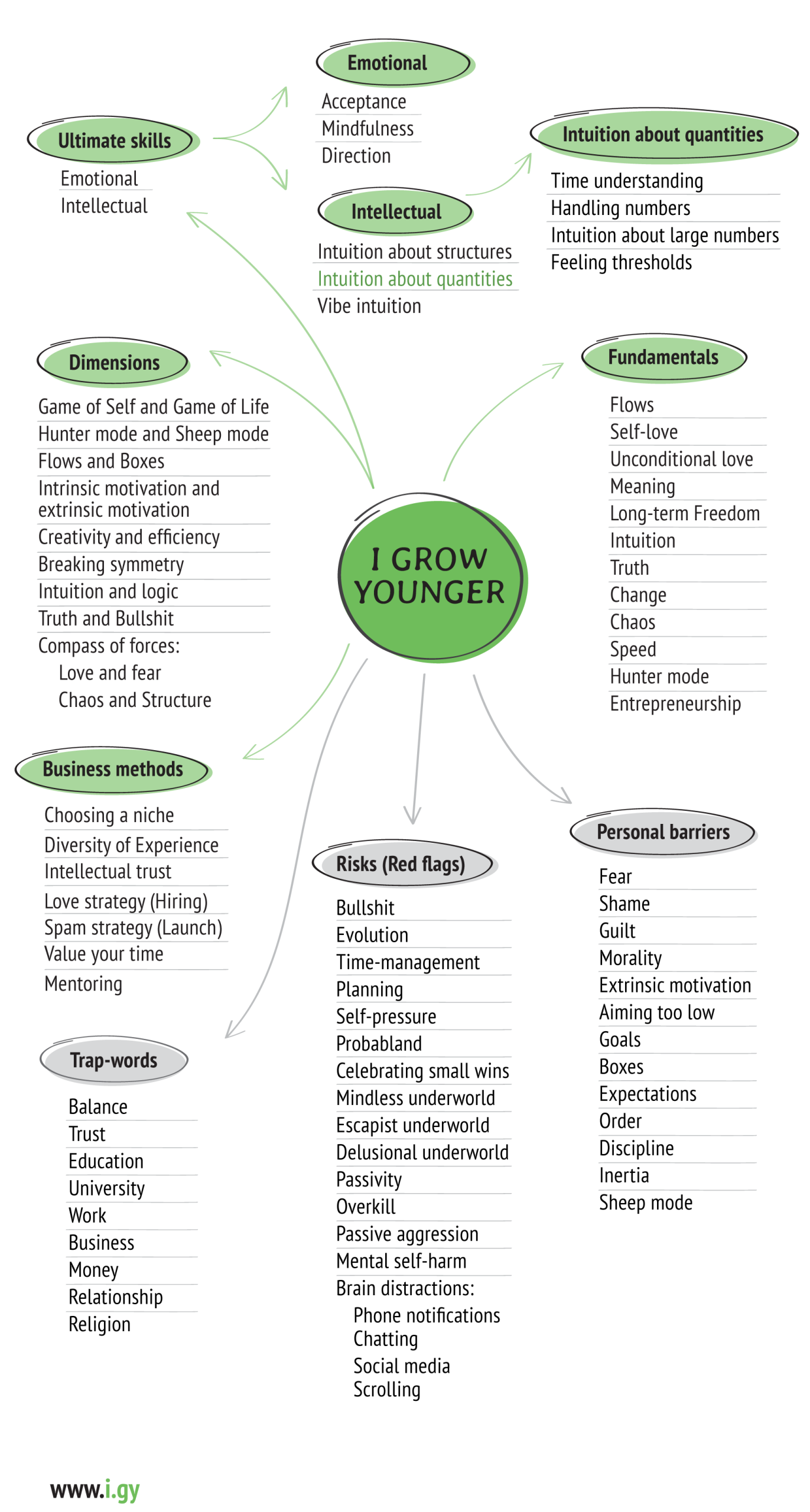
The purpose should not be to produce an obedient, successful or high-performing child. It should be to help a young person gradually build a good internal map so that, when the parent is no longer making decisions for them, they can navigate life themselves. During the first years, you are almost everything: protection, resources, structure, information, emotional security and decision-making. Over the following sixteen years, you should gradually transfer more and more of those functions to the child.
Brain fragmenting distractions and Boxes
This time, we will start with the Risks (Red flags). The biggest risk for families, parents and their children are the screens and all the other risks resulting from their use. There is already an extensive scientific research on the topic as well as a wide range of popular science books.
In IGY we focus on the so called Brain fragmenting distractions – Phone notifications, Chatting, Social media, Scrolling and so on. These are all Boxes that lead to further Boxes and minimise opportunities to experience Flows.
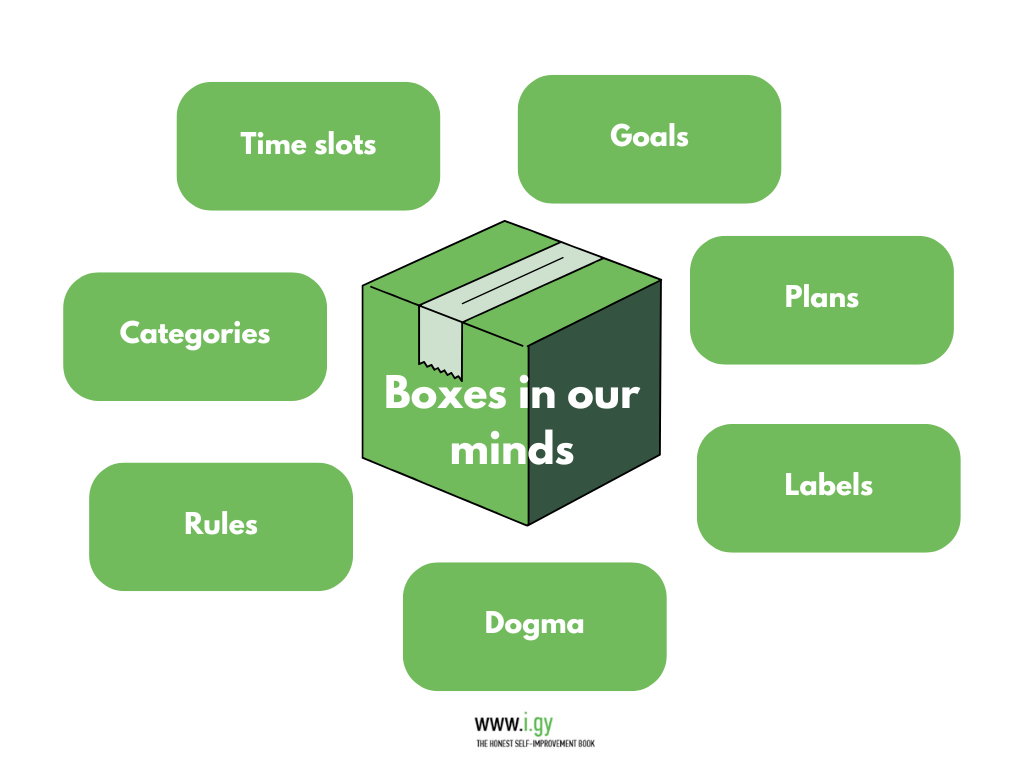
Your child should have less Boxes than you.
Children are extraordinarily easy to put into Boxes because adults love classification. Even praise can become a Box. If everyone tells a nine-year-old that she is “the smart one,” being confused at twelve can become an identity crisis rather than a normal part of learning. So better describe what happened rather than defining who the child is.
“You solved that very quickly.”
not
“You’re a genius.”
“You didn’t put much effort into this one.”
not
“You’re lazy.”
Thus the child remains free to surprise everyone – including themselves.
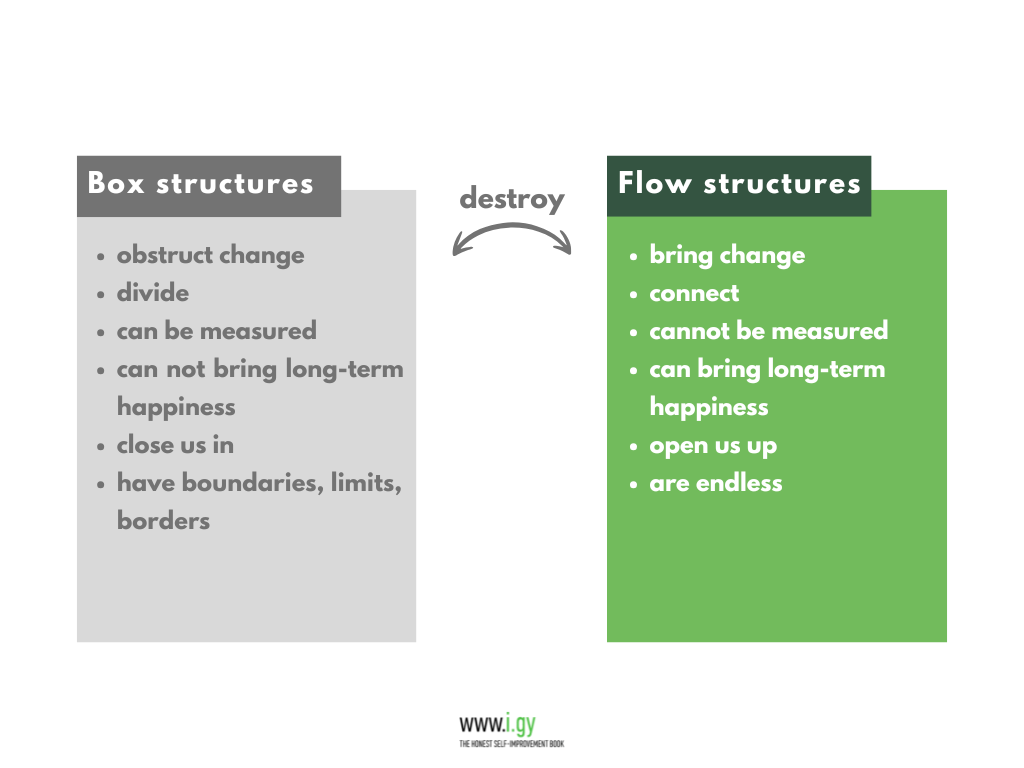
Flows
If we had to define “childhood” in a single word, it would be Flow. Every child is naturally in a Flow and should remain in such a state as much as possible. The most important Flow for any child is the so-called “free play”. Other common Flows are games; sports – especially team sports involving a ball; dancing and books. And nature. The more time children spend outdoors in nature, the better.
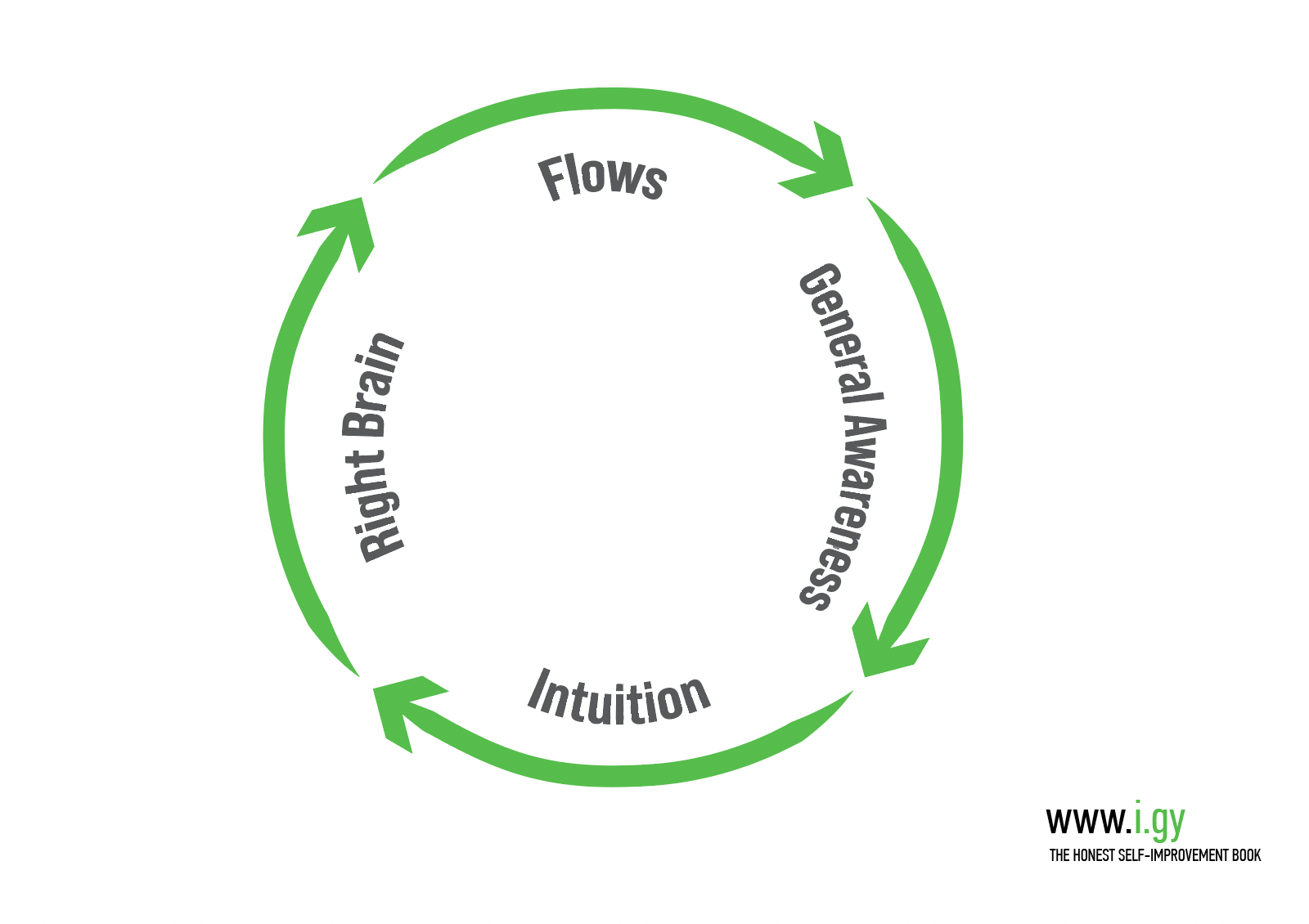
Intuition
The ultimate Flow for almost every child is the free play outside. It develops its Intuition directly and also indirectly through the Diversity of Experience it enables. Intuition is later on crucial for everything else. It’s at the core of IGY and is one of the fundamentals.

Core Flows and Secondary Flows
The Core Flows are Self-love, Unconditional love, Meaning, Responsability, Scaling, Freedom and Intuition. Here is what each Core Flow does when it becomes a part of you and a part of your child:
- Self-love – destroys the Barriers within, you see yourself and your life experience as one whole. Never make Self-love and Self-worth dependent on grades, behaviour, talent, appearance or achievement.
- Unconditional love and compassion for others – destroys the barriers between you and other people. Love the child independently of what they do. You may strongly oppose an action without withdrawing love.
- Meaning – destroys all other barriers in the world, seeing it as a whole. Help your child discover what makes it genuinely care, rather than supplying them with a life purpose.
- Responsibility – destroys all barriers between our values and taking action on them. Gradually let your child’s actions become its own actions, including reasonable consequences.
- Growth / Scaling – destroys all barriers that slow us down on our mission to contribute to the world – eg. the false belief that we’re not made for greatness. Don’t freeze your child into an identity. Allow constant rewriting of the map.
- Intuition: Don’t answer every question for them. Give them room to notice what they like, dislike, fear, care about and feel drawn toward.
- Freedom: Increase real choice as your child’s ability to handle it develops.
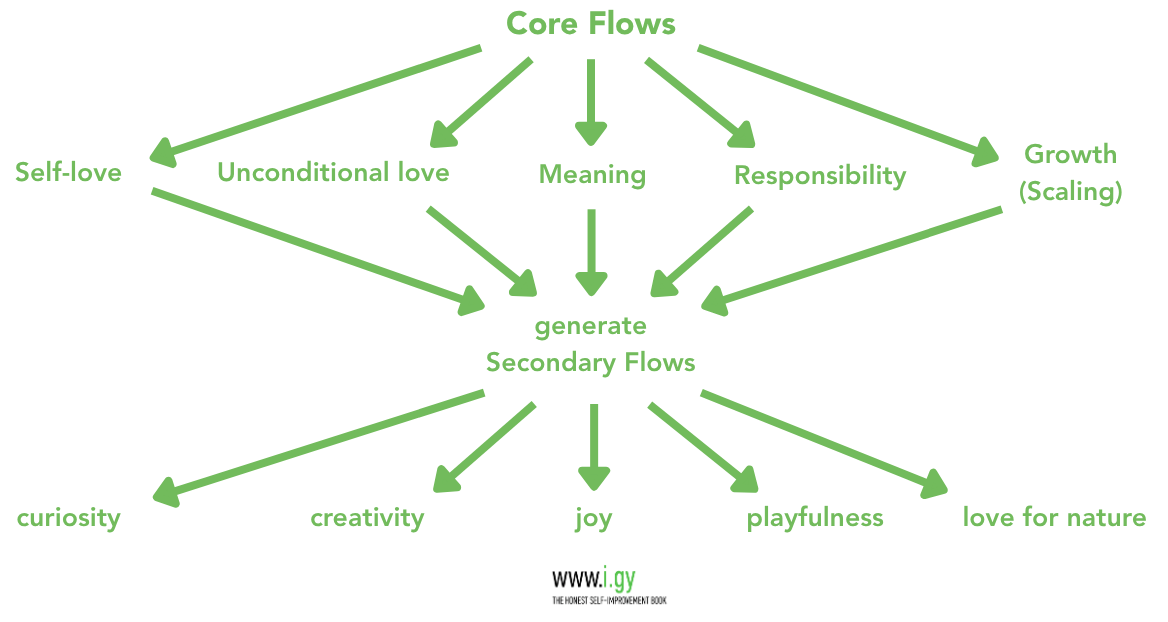
Those generate secondary ones such as Curiosity, Playfulness, Joy, Love for nature and other wonderful Flow mixes.
The real signs of healthy child development are not grades and achievements, but stronger Core Flows. Instead of asking mainly:
“How are the grades?”
“Did you win?”
“Did you behave?”
“How many competitions did you enter?”
“Are you ahead of the other kids?”
look at something closer to this:
“Does this child basically like themselves?”
“Can they deeply care for somebody other than themselves?”
“Do they care about anything larger than immediate pleasure?”
“Can they turn something they care about into action?”
“Are curiosity, creativity and play expanding?”
“Are their meaningful options expanding?”
The Ultimate skills
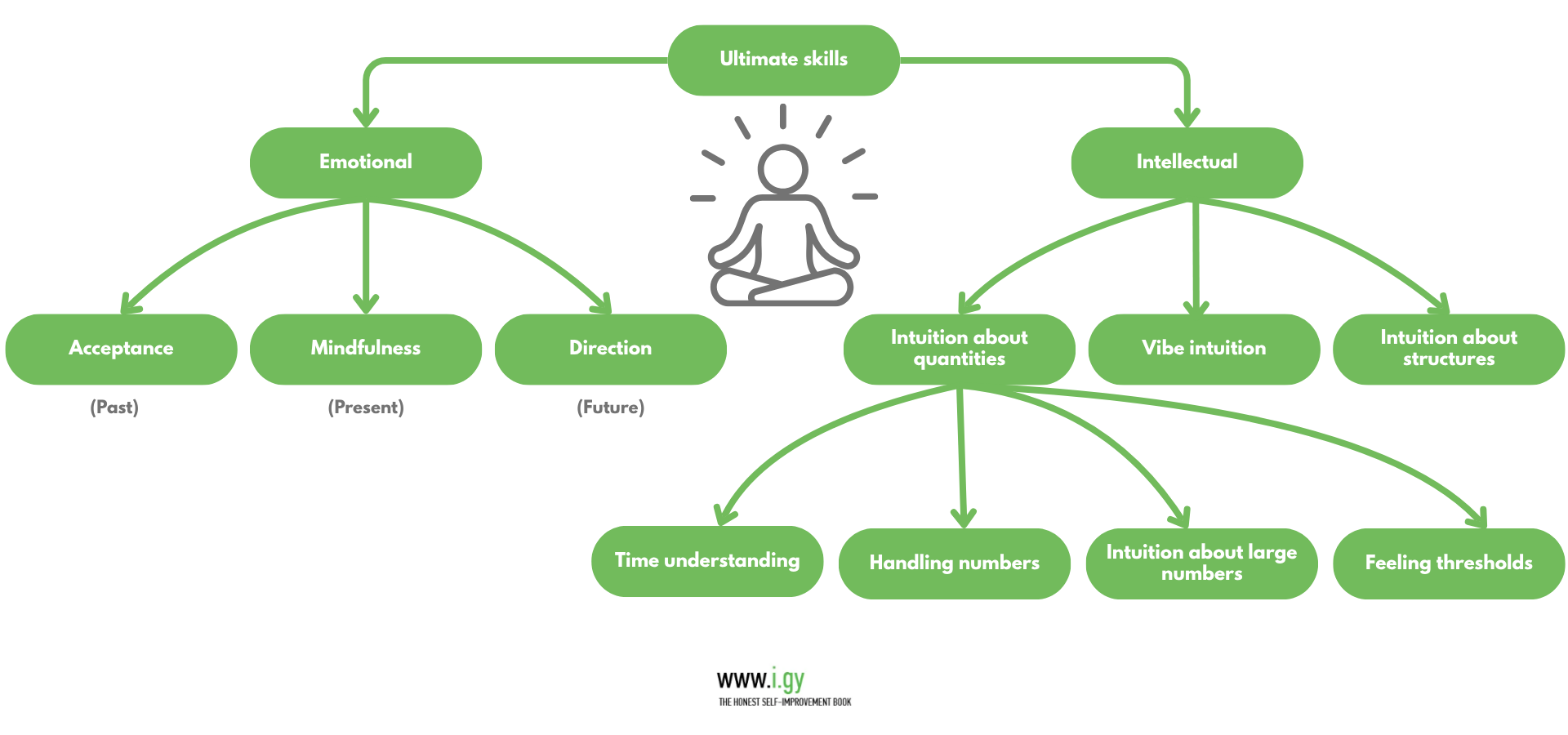
The Ultimate skills are two types – Emotional Ultimate skills and Intellectual Ultimate skills. The Emotional Ultimate skills are Acceptance, Mindfulness and Direction. The Intellectual Ultimate skills are Intuition about quantities and Intuition about structures. All Ultimate skills are Flows.
Intuition about Structures
Intuition about structures is the ability to see relationships: causes and consequences, systems, patterns, dependencies and chains of events. As a parent you should help the child understand how things work. Children are often given only final conclusions and thus they have no chance to understand the structure behind them.
A parent can therefore gradually move from:
“Don’t do this.”
toward:
“What do you think will happen if you keep doing this?”
That small change is important. The parent is no longer merely supplying the answer. They are teaching the child to construct a model of the situation. Imagine a child who repeatedly leaves their schoolwork until late in the evening. A purely rule-based response might be:
“Homework before games. That is the rule.”
A structure-oriented conversation is different:
“You play first. Then homework starts late. By that point you are tired. Because you are tired, it takes longer. Then you go to bed later. Tomorrow you are even more tired. What do you think happens if this repeats for several days?”
The child begins to see a chain, rather than an isolated event. With enough experience, the reasoning gradually becomes intuitive. The child starts recognizing patterns without needing a parent to explain every one of them. This is one of the central transitions in growing up: At first, the parent sees the consequence tree for the child. Eventually, the child begins to see it for themselves.
And that changes what parental boundaries are for. A boundary should not only stop an undesirable action today. Whenever possible, it should help the child understand the structure that made the boundary necessary.
Intuition about Quantities
Intuition about quantities concerns our intuitive understanding of Time, Money, Numbers, probabilities and thresholds. We distinguish the following: Handling numbers, Time understanding, Intuition about large numbers and Feeling thresholds.
A child (exactly like an adult) can be excellent at mathematics and still have poor Intuition about quantities. They may solve percentages perfectly on a worksheet but have no idea whether a 30% discount actually makes a purchase worthwhile. They may calculate probability correctly in class but dramatically overestimate a frightening one-in-a-million risk. They may read a clock perfectly but consistently underestimate how long it takes to get ready. This all can be shown by the parents and learned by the child.
Handling Numbers
Children are introduced to numbers very early. They may learn to calculate numbers before they learn what numbers actually mean. The real challenge is not arithmetic itself, but understanding the abstraction behind a number: What does this number represent? In what context? What can it tell us, and what can it not tell us?
We use numbers not only as tools, but as judgments: grades, test scores, rankings, points, likes, followers, age expectations, money, performance statistics and eventually salaries and status. Numbers can be very useful in the Game of Life, but when a grade, ranking or another measurement begins to represent the child’s worth, the number has crossed into the Game of Self and becomes extremely dangerous.
A parent therefore has two jobs. The first is to make the child good with quantities. The second is to make sure the child does not become defined by quantities. One of the healthiest relationships with numbers a parent can help build is therefore: Use numbers to understand reality. Always use exact numbers and probabilities when speaking with your child. But never use number to describe your worth. In other words – we need to raise children who can do two things simultaneously: take numbers seriously without taking them personally.
We want a child who can calculate, estimate, compare, budget, understand probability, recognize exponential growth, feel Time, notice thresholds and make decisions with quantities.
We also want that same child to be able to receive a bad grade without becoming a worse person in their own eyes.
Lose a competition without losing Self-love.
See somebody else’s follower count without becoming envious.
Earn less than somebody else without assuming they are less successful as a human being.
Become older without interpreting age as decreasing worth.
Have more money without believing money makes them more valuable.
For a deeper insight at the topic, visit Teaching Kids What Numbers Represent and How to Handle Them, where you’ll find practical real-world examples and guidance for many of the everyday situations parents face.
Feeling Thresholds
Feeling thresholds is crucial. A Threshold is the upper or lower boundary of a Quantity at which a further quantitative change produces a change in Quality — a change in the structure of the situation itself. Or to translate it in a language suitable for a child: learning when “more” becomes “different”.
Much of life does not work according to simple categories such as good / bad, safe / dangerous or enough / not enough. Something can be perfectly fine at one quantity and destructive at another. One piece of chocolate is different from twenty. Fifteen minutes online is different from five hours. Being nervous before an exam is different from being so anxious that you cannot function. Spending €10 is very different when you have €20 than when you have €2,000. One night with little sleep is different from sleeping too little for six months. A joke can be playful when it happens once and humiliating when it continues after somebody has asked for it to stop. The mature question is therefore often not:
“Is this good or bad?”
but:
“How much is too much?”
A parent helping a young child is useful. More help is not necessarily even better. At some point, help can cross a threshold and become replacement: the parent is now solving the child’s problems instead of supporting the child in solving them.
The same principle applies to protection. Too little protection can expose a child to risks they cannot handle. But more and more protection does not necessarily create more and more safety. Beyond a certain point, it can begin to remove experience, competence, confidence and eventually Long-term Freedom.
One of the most important lessons a child can learn is that human thresholds differ. One child can spend three hours at a crowded birthday party and still be full of Energy. Another has reached their limit after ten minutes. One teenager can take criticism from a coach and immediately use it constructively. Another may already be under enormous internal pressure, and the same criticism pushes them into shame or withdrawal. One child needs a parent nearby before trying something new. Another experiences the same parental presence as interference. This is why good parenting is trying to develop the ability to notice thresholds.
For a child, human thresholds eventually become social Intuition. How much can I tease a friend before the joke is no longer funny? How many times can I cancel plans before another person stops trusting me? How strongly can I disagree without turning the disagreement into humiliation? How much can I ask from another person before cooperation begins to feel like exploitation? How long can I remain silent when somebody is treating me badly before I need to speak?
The sophisticated skill is not simply learning rules such as “never tease” or “always help your friends.” It is learning to feel what is happening to the other person and recognize when the relationship is approaching a critical threshold.
Children also need to discover their own thresholds. A child needs gradually to learn: How tired am I before my judgment deteriorates? How much social activity energizes me, and when does it exhaust me?How much difficulty makes something interesting, and when does it become overwhelming? How much pressure helps me act, and when does it make me freeze? How much time online leaves me feeling good, and when do I start feeling empty or agitated? How long can I tolerate a situation before I need to change something?
This is much more valuable than giving the child a lifetime supply of externally imposed limits. A seven-year-old may need the parent to say
“It is bedtime.”
A sixteen-year-old should increasingly be able to notice
“If I keep doing this for another hour, tomorrow is going to be terrible.”
The rule has slowly become Intuition.
Thresholds explain why the same parenting method can help today and harm tomorrow. This is particularly important as children grow. A behaviour from the parent can remain exactly the same while the child changes enough that the effect crosses a threshold.
At age five:
“I’ll choose this for you.”
may provide security.
At age fifteen:
“I’ll choose this for you.”
may communicate:
“I don’t trust your judgment.”
This is why parenting needs continuous recalibration. The question is not only:
“What worked before?”
but:
“Has something changed enough that my response should now change too?”
Thresholds are also central to transferring responsibility. Parents should watch for competence thresholds. A child who can reliably cross a road safely no longer needs to have their hand held every time. A child who has learned to manage a small amount of money can be trusted with more. A teenager who repeatedly communicates where they are, respects agreed times and responds sensibly when plans change has demonstrated something important. They have provided evidence that the threshold for additional Freedom may have been reached.
So rather than:
Age → Freedom
the process becomes:
Experience → competence → demonstrated responsibility → more Freedom.
And then the new Freedom creates further experience, which may eventually allow another threshold to be crossed. That creates an upward spiral:
Freedom → experience → Intuition → Responsibility → greater Freedom.
This is very close to what we want adolescence to accomplish.
There is another subtle point – parents should help children approach thresholds, not constantly prevent them from reaching them. If parents always intervene before the child reaches any meaningful threshold, the child cannot learn what those thresholds feel like. If we always remind them before they forget, they do not experience forgetting. If we always resolve the disagreement, they never discover how conflict develops. If we always stop them before they become tired, frustrated or disappointed, they have fewer opportunities to learn what tiredness, frustration and disappointment feel like before they become overwhelming.
It means to allow safe contact with consequences. A parent can sometimes let the child get close enough to a threshold to recognize it:
“I think you’re becoming very tired. Can you feel the difference from an hour ago?”
“You were having fun with him earlier. Something seems to have changed. When did it stop being fun?”
“You’ve been working on this for forty minutes. Are you still productively struggling, or are you just stuck now?”
This converts experience into Intuition. All limits gradually need to become internal. At first:
“Mom says I’ve had enough.”
Later:
“I think I’ve had enough.”
Eventually:
“I know what happens to me when I go beyond this point, and I don’t want to go there.”
Parenting should aim for the following:
First, lend the child your Intuition. Then help them build their own. When they are small, you see structures and quantities that they cannot yet see. As they grow, explain more of what you see. Then ask them what they see. Then allow them to make increasingly meaningful decisions. And eventually, there will be situations where their understanding is better than yours.
That should not be experienced as a loss of parental authority. It is one of the outcomes you were trying to create. The final goal is not a sixteen-year-old who has memorized the parent’s rules. It is a young person who can look at a complicated situation and intuitively ask:
“What is really happening here?”
“What will this lead to?”
“How much matters?”
“Where is the threshold?”
“What am I risking?”
“What am I gaining?”
“And where is this taking me over time?”
Intuition about large numbers
Our real choice spaces are often vastly larger than they feel to us. For example, someone may imagine choosing among a thousand possible jobs when the real space of possibilities is closer to millions. Because large numbers are difficult to comprehend, we need an Intuition for them. Most people develop an understanding and Intuition about hundreds, some even about thousands, but very few feel millions and more.
Children learn to count long before they learn to feel scale and do Scaling. A thousand, a million and a billion may all simply sound like “a lot,” yet much of the modern Game of Life depends on understanding the enormous differences between them. Intuition about Large Numbers means developing a feeling for scale and Scaling: how huge option spaces really are, how small actions accumulate, how growth compounds, how rare events appear when millions of attempts are made, and how a small percentage can represent a large reality. For a child, perhaps its most liberating lesson is this: the world is almost always larger than the part of it you can currently see. There are more paths, people, ideas, solutions and possible futures than your personal map can contain. You do not need to explore all of them. But you should never mistake the few options in front of you for all the options that exist. Small numbers can be counted. Large numbers have to be understood. Intuition about Large Numbers is the ability to feel how much larger reality is than the small sample currently visible to you.
But before we start in detail, we need to make clear why we need extra Intuition about large numbers next to Handling numbers and Feeling thresholds. They may be quite similar, but there are crucial differences. Handling Numbers asks:
“What does this number represent, and how should I use it?”
Intuition about large numbers asks:
“Can I actually feel the scale of this quantity and how the world changes when quantities become enormous?”
And Feeling thresholds asks:
“At what quantity does a structural change occur?”
They overlap, but they are not identical. For example, a teenager sees 1,000,000 views.
Handling Numbers:
“What exactly does a view measure?”
Intuition about large numbers:
“How large is a million relative to the populations and audiences I know?”
Feeling thresholds:
“At what audience size does publishing something create qualitatively different risks or opportunities?”
Intuition about structures:
“What caused the video to spread?”
Vibe Intuition:
“Where is this attention taking the person over time?”
Teach the child to feel scale. Young children understand small quantities through direct experience. Three apples. Five friends. Ten euros. Twenty minutes. (The last two examples need a longer time, even years of experience). These quantities can still be imagined almost as individual objects. But eventually life begins presenting quantities that can no longer be mentally pictured in the same way: thousands of people, millions of possible choices, years of accumulated time, large amounts of money, very small probabilities repeated many times, rapidly growing systems, huge online audiences, large datasets, and consequences that accumulate over hundreds or thousands of repetitions. At that point, simply knowing how to read the number is not enough. A child may know what 1,000,000 means mathematically without having any real feeling for its size. That distinction is central. Knowing the symbol is not the same as feeling the scale. And that is what Intuition about large numbers should mean in parenting.
Large numbers distort our sense of reality. Suppose a child hears:
“1,000 people watched this.”
Then:
“100,000 people watched this.”
Then:
“10 million people watched this.”
All three may simply register emotionally as:
“A lot.”
Once numbers exceed what we encounter directly, they often collapse into vague categories: big, very big, huge. But these quantities can represent radically different realities. That matters because the modern Game of Life increasingly operates at scales children cannot directly experience. A teenager can post something from their bedroom and theoretically expose it to more people than they could physically meet in a lifetime. A tiny percentage of a very large population can still mean a very large number of people. A small repeated cost can become important when multiplied across months or years. A small difference in growth can create a huge difference over a long enough period. A tiny probability can matter when an activity is repeated enough times. So Intuition about large numbers is partly the ability to resist the mental shortcut:
“They are both big, therefore they are roughly the same.”
They may not be remotely the same.
Children should learn orders of magnitude, not merely digits. One useful parenting approach is to make children compare numbers by scale. Do not only ask:
“What is bigger?”
Ask:
“How much bigger?”
A thousand and a million are not just two big numbers. One belongs to a completely different scale. Likewise: €10 versus €100. 100 people versus 10,000. One hour versus 100 hours. A 1% chance versus a 50% chance. The important cognitive step is learning to notice when adding zeros changes the nature of the situation. This is particularly useful because children may otherwise treat differences linearly. So the parent can regularly bring large quantities back to something concrete:
“How many classrooms would that be?”
“How many months of your pocket money would that represent?”
“How many days would that take?”
“How many people could fit in our school?”
The purpose is not perfect calculation. It is building anchors. Large numbers become meaningful when the mind has something familiar to compare them with.
Intuition about large numbers expands the child’s sense of possibilities. This is where the concept connects beautifully with Long-term Freedom. We often perceive the number of available options as much smaller than it really is. That can be extremely important for adolescents. Ask a teenager:
“What can you study?”
They may think of twelve possibilities.
“What jobs could you have?”
Maybe twenty.
“What could you do after school?”
Perhaps five familiar options. But the actual space is enormous. There are thousands of professions. Thousands of combinations of skills. Different countries. Different types of organizations. Different business models. Different ways to earn money. Different lifestyles. Different combinations of part-time work, projects, education and entrepreneurship. And new possibilities continually appear. The child normally sees only the options present in their personal map. Their parents’ professions. Their teachers’ professions. Jobs their friends mention. Jobs portrayed online. Traditional university subjects. The problem is therefore not simply a lack of information. It is a failure to feel the size of the option space. A teenager who thinks:
“I have three choices.”
behaves very differently from one who intuitively understands:
“There may be hundreds of paths I haven’t encountered yet.”
That second child has more psychological Freedom before anything external has changed.
Do not force children to choose too early from a tiny sample. We repeatedly ask children enormous questions based on tiny datasets:
“What do you want to become?”
“Which subject will you specialize in?”
“What university will you attend?”
“What career do you want?”
But perhaps the child has directly experienced only a microscopic fraction of the available possibilities. Imagine asking someone:
“What is your favourite food?”
after allowing them to taste only three foods. The question is premature. The same can happen with life direction. This connects Intuition about large numbers with Diversity of Experience. If the possible world is enormous, then one of the parent’s jobs is to continually enlarge the sample from which the child builds Intuition. Not because the child needs to try everything. That is impossible. But because they need enough diversity to understand:
“The world is much larger than the part of it I currently know.”
That is an enormously liberating realization.
Large numbers teach intellectual humility. When the possibility space is huge, we should become less certain that the few options visible to us contain the best answer. Humans rarely have their best option among the options they currently choose from. A child says:
“There are only two things I can do.”
The parent can ask:
“Are those really the only two things—or are they the only two things we have thought of so far?”
That final phrase matters: so far. It keeps the structure open. The same applies to conflict:
“Either I stop being friends with her or I accept everything she does.”
Are those really the only possibilities? Or school:
“Either I’m good at maths or I’m stupid.”
Only two possibilities? Or the future:
“Either I get into this school or everything is ruined.”
Again, the imagined option space has collapsed. Large-number intuition can therefore become a defence against false binaries. If life contains millions of possible combinations, two visible options should not feel like the whole universe.
Large numbers also matter because repetition changes everything. There is another dimension of the parenting framework: a small event repeated a large number of times can become a major force. One sweet is not a lifestyle. One late night is not a sleep pattern. One unkind remark is not necessarily an abusive relationship. One skipped homework assignment is not an academic trajectory. One hour online is not a childhood. But repeated hundreds or thousands of times, tiny actions can build structures. This connects Intuition about large numbers to direction and Vibe Intuition. The question becomes:
“What happens if this small thing happens again and again?”
A child often experiences each event separately:
“It’s only today.”
“It’s only €2.”
“It’s just ten minutes.”
“It’s only one video.”
“It’s only one practice session.”
And individually, they may be right. But life is built from repeated individual moments. So parents can help children develop a second perspective:
“Yes, once is small. What happens if you repeat it 300 times?”
The objective is not to frighten children with accumulation. It is to teach them to zoom out.
Teach the difference between absolute numbers and relative numbers. Imagine two schools. One has 1,000 students and 20 incidents. Another has 100 students and 10 incidents. Simply hearing:
“20 versus 10”
can make the first sound worse. But the populations are different. Children should gradually learn that:
“How many?”
and
“What proportion?”
are different questions. Similarly:
“This video has a million views.”
Sounds extraordinary. But compared with what? How many people could potentially have seen it? How many views do similar accounts receive? Over what period? Large numbers can impress us simply because they are large. Context prevents that. This fits directly with the broader IGY Numbers principle that the central problem is not numerical operations but understanding what the numbers represent and what their context is.
Large audience numbers can create false importance. This is particularly relevant to adolescents. Imagine a teenager sees: 4 million views. 100,000 likes. 600,000 followers. Those numbers can create an automatic inference: Important. True. Good. Worth listening to. But audience size measures audience size. Nothing more. It does not directly measure: Truth, expertise, kindness, quality, wisdom or relevance to this particular child. This is where numbers and Truth meet again. The parent can ask:
“What exactly does 4 million views prove?”
The correct answer is essentially: That the content was viewed around 4 million times. Everything else needs additional evidence. That is a crucial form of numerical discipline.
One person and one million people create a moral challenge. Human empathy is naturally good at individuals. One frightened child. One injured animal. One family in difficulty. Those are emotionally imaginable. A million people suffering can paradoxically become less vivid, because “one million” turns into an abstraction. So Intuition about large numbers should not mean replacing people with statistics. It should mean learning to move in both directions:
person → scaling
and
scaling → person.
If one child lacks clean water, you can imagine the child. If millions do, you need numbers to understand the scale. You need both. The story makes humanity visible. The number makes scale visible. Neither is enough alone. That would connect Numbers with Unconditional Love, Meaning and Scaling.
Children should learn to break huge quantities into understandable units. When a quantity is too large to feel, one solution is decomposition. Suppose a teenager wants to understand a huge amount of money. Instead of staring at all the zeros, translate it into: years of ordinary income, houses, school budgets, months of living expenses, number of employees or whatever comparison is meaningful. Similarly, enormous periods of time can be translated into: lifetimes, school years, generations. Large populations can become: cities, schools, stadiums, families. The important skill is: When a number becomes too large to understand directly, build another representation. That is exactly what good Intuition about quantities requires. The child is no longer intimidated by the number. They know how to make it meaningful.
But comparisons can also manipulate us. A comparison can clarify a large number, but it can also be chosen to create an emotional effect. Someone may say:
“This amount could buy 10,000 pizzas.”
That makes it sound enormous. Or:
“It costs only one cent per day per person.”
Now the same total may sound tiny. Both statements can be mathematically correct. So once children become good at comparisons, teach the next question:
“Why did they choose that comparison?”
This brings us straight back to Truth. Numbers are not automatically objective just because arithmetic is involved. The underlying measurement may be correct while the framing is selective.
The option-space problem is especially important for adolescents. A young person at 15 or 16 may feel trapped because their immediate environment seems small. Five close friends. One school. A few subjects. Several possible universities. A few familiar professions. One town. One current version of themselves. Their present world can feel like the world. Intuition about large numbers gives them another perspective: There are enormous numbers of people they have not met. Places they have not visited. Skills they have not tried. Fields they do not know exist. Projects nobody around them has considered. Ways of combining interests they have never seen. Future versions of themselves they cannot currently imagine. This does not mean telling a distressed teenager:
“There are billions of people in the world, get over it.”
That would destroy the emotional point. The Game of Self still needs Acceptance and Love. But Intuition about large numbers can gently reopen the Game of Life:
“What you see right now is a very small sample of what exists.”
That can be a powerful Long-term Freedom message.
Large-number intuition should reduce FOMO (fear of missing out). There is an interesting paradox. If children understand that there are millions of possibilities, they might conclude:
“Then I’m missing almost everything!”
Technically, they are. Everyone is. That is exactly why the lesson cannot be:
“Try everything.”
It should be:
“You can never try everything, so don’t expect yourself to.”
Intuition about large numbers should create Freedom from the fantasy of complete optimization. There will always be: another book, another friend, another country, another hobby, another career, another opportunity. The goal is not to identify the mathematically perfect life from millions of possible lives. The goal is to develop enough Intuition that good directions become visible and then move outward. You do not need the entire tree of a million possibilities mapped in advance. You need a good next move. A Hunter move. Only one. And then another one and so on.
Intuition about large numbers also protects against premature certainty. A child may say:
“This is definitely the best school.”
“Best among how many schools you’ve actually examined?”
“This is the only job I want.”
“How many kinds of work have you really seen?”
“This is the best country to live in.”
“How many societies do you know well?”
Again, we should not turn every conversation into interrogation. The deeper lesson is: Your confidence should partly reflect the size of your sample compared with the size of the world. If you have seen 3 possibilities out of thousands, extreme certainty deserves caution. This is where Intuition about large numbers supports intellectual humility and Truth.
An action can be small in itself but enormous when replicated. Helping one person is meaningful. Creating a structure that helps one person a million times—or helps many people—changes the scale of the action. IGY’s Long-term Freedom concept connects increasing Freedom with Scaling one’s positive effect on others. For children, we obviously do not need to demand global impact. But we can build the mindset and plant the Intuition:
“What happens if this works for more than one person?”
A child makes study notes. Could they help a friend? Could they help the whole class? Could the method become something reusable? A teenager solves a small problem. Can the solution be repeated? That is early Scaling thinking. Not:
“You must become huge.”
But:
“Notice when something useful can multiply.”
Small probabilities and large numbers interact. A very unlikely event may be unimportant when there is only one opportunity for it to happen. But when there are enormous numbers of opportunities, rare events stop feeling so mysterious. Similarly, if millions of people try something, it should not surprise us that a few achieve extraordinary outcomes. That helps children interpret online stories. Suppose they see:
“Teenager earns a fortune from one video.”
The story may be true. But the relevant Truth question is not only:
“Did this happen?”
It is:
“Out of how many people trying did this happen?”
Without the denominator, rare successes can look ordinary. This connects large numbers, Intuition about probability and Truth. Children should learn: An example proves that something can happen. It does not tell you how likely it is to happen.
“A little percentage” can create a large effect at scale. This follows naturally. Children often interpret percentages without considering the base.
“Only 1%.”
That sounds tiny. One percent of 100 is a small quantity. One percent of millions is something completely different. So one core question in Intuition about large numbers should be:
“Percentage of what?”
Similarly:
“Only €1.”
Once? Per day? For one person? For a million customers? For ten years? Without Scaling and repetition, the number tells us very little. This can become a simple family habit – whenever someone says:
“Only 2%…”
ask:
“2% of what?”
Whenever someone says:
“It’s just €5…”
ask:
“Once, or repeatedly?”
Whenever somebody says:
“Almost nobody does this…”
ask:
“How many people would that actually be?”
That is Intuition about large numbers operating in everyday language.
Intuition about large numbers is closely related to exponential growth and the Exponential function. This is a particularly important form of Intuition about large numbers because human expectations are often approximately linear. We intuitively imagine:
one more step → roughly one more unit of result.
But some processes compound. Growth acts on previous growth. When a growing quantity repeatedly doubles, the new value eventually exceeds all of its earlier values combined. A child does not initially need equations to understand this. Use simple doubling experiences: 1, 2, 4, 8, 16, 32… At first, the growth appears slow. Then suddenly the quantities become large. This creates an intuitive lesson: Growth can look insignificant for a long time and then become enormous. That is useful far beyond mathematics. It helps children understand: money growing over time, audiences growing, technology spreading, information spreading, skills accumulating, businesses scaling and some risks multiplying. But here we should be careful: not everything in human development grows exponentially. The educational aim is to recognize when compounding applies, rather than seeing exponential growth everywhere.
The Exponential function
The exponential function deserves its own attention under Intuition about Large Numbers, because it exposes one of the clearest gaps between being able to calculate something and actually being able to feel what the quantity is doing. We explicitly connect the problem of quantities with time: we often need to understand money and other quantities over long periods, yet our Intuition for both quantity and time is weak.
One of the hardest quantities to feel is exponential growth. We intuitively expect the future to resemble the recent past: if something grew a little this year, we expect it to grow a little more next year. But when growth compounds, every increase becomes part of the base for the next increase. The first steps may look insignificant while the later ones become enormous.
Teach children the difference between adding and multiplying, between a fixed increase and a repeated percentage, and between a one-time event and a process that reinforces itself. Let them guess before calculating. Let them experience how badly Intuition can underestimate repeated doubling. Then show them how the same principle appears in money, debt, audiences, information, repeated habits and other systems.
But teach the limit too: not everything grows exponentially, and nothing in the real world grows and compounds forever. The useful question is not “Is this growing?” but “What is the growth mechanism, can growth create more growth, what could stop it, and which threshold will be crossed if it continues?”
Linear Intuition asks how much is added next. Exponential Intuition asks how much the growing quantity itself changes the next step. Or even more simply: Exponential growth is when growth starts producing more growth. That sentence is probably simple enough for a child and still captures the core idea.
Exponential growth: when “a little more” repeatedly becomes enormous. Children naturally understand linear growth much more easily. If I give you €5 every week: €5, €10, €15, €20, €25 – the total sum increases by the same amount each time. That is intuitive. But now imagine that instead of adding the same amount, the quantity repeatedly grows by the same percentage or multiplies by the same factor. 1, 2, 4, 8, 16, 32, 64, 128… At first, nothing looks particularly dramatic. The first few steps are tiny. That is precisely why exponential growth is difficult to feel. Our intuition sees:
small → small → still small → somewhat bigger…
and expects the future to continue in roughly the same way. But it does not. Eventually the later steps dominate everything that came before. That is the Intuition we want the child to develop: When growth compounds, the beginning can be misleading.
The difference between adding and multiplying. Suppose two children receive pocket money for ten weeks. The first receives €10 more every week. The second begins with €1, but the amount doubles every week. The first pattern is additive. 10, 20, 30, 40, 50, 60, 70, 80. The second is multiplicative. At first, the doubling child looks much worse off: 1, 2, 4, 8 while the other arrangement may already involve tens of euros. But the structure of the process is different. After another few doublings: 16, 32, 64, 128, 256, 512, 1024. Suddenly the “tiny” quantity has become large. The lesson is: Before judging a quantity, understand how it changes. A number tells us where something is now. The growth rule tells us where it may be going. That connects exponential thinking directly with Vibe Intuition: not simply seeing the current quantity, but understanding its direction over time.
A child can understand exponential growth before understanding equations and complicated maths. The intuitive concept can come first: Something grows. The growth becomes part of the next starting point. Then the next growth happens on top of what has already grown. That is compounding. Imagine a snowball. You roll it once and it picks up some snow. Now it is larger. When you roll it again, the larger snowball has more surface available to collect even more snow. The result is not: small + small + small. It is more like: growth creating the conditions for more growth. That is a much better intuitive picture.
The classic doubling exercise is extremely useful. Ask a child:
“Would you rather receive €1 million immediately, or one euro today that doubles every day for thirty days?”
Most people initially feel that €1 million must obviously be better. But if we start with €1 on day 1 and double it each day, the amount on day 30 is more than €1 billion. 1000 times more! What matters educationally is not the surprising answer. It is what happens before the answer. Ask the child to guess. Most will underestimate it enormously. Then write down the sequence. For a long time it looks unimpressive. That experience is valuable. They can feel themselves being wrong about exponential growth. And that is how Intuition develops. Not:
“Memorize that exponential growth is fast.”
But:
“I have seen how badly my Intuition underestimates compounding.”
That is a much deeper lesson.
Doubling time is often easier to understand than percentages. IGY specifically uses doubling time as the intuitive bridge. If a quantity grows at roughly 7% per year, the doubling time is around ten years, using the simple approximation 70 ÷ growth rate. This is often called the Rule of 70. So instead of telling a teenager:
“This quantity grows by 7% annually,”
which sounds fairly modest, say:
“At that rate, it roughly doubles every ten years.”
Now the scale becomes much easier to imagine.
5% annual growth → roughly doubles in 14 years.
7% → roughly 10 years.
10% → roughly 7 years.
This changes how a child hears percentages. “7%” sounds small. “Double in about ten years” does not. That is exactly why exponential Intuition matters.
Small percentages can be huge when time is long. Suppose a teenager hears:
“Prices increase by 3% a year.”
Three percent sounds almost trivial. But repeated year after year, the effect compounds. The useful parenting question is therefore:
“3% for how long?”
That connects three forms of Intuition about Quantities: Handling numbers – 3%, Time understandig – over many years, Intuition about large numbers – what happens after repeated compounding. The child learns that percentages cannot be interpreted without time.
Likewise:
“An investment earns 6%.”
“Debt costs 15%.”
“A population grows by 2%.”
“A business grows revenue by 20%.”
None of those statements can really be understood from the percentage alone. The next question is:
“For how many periods, and does the growth compound?”
Money is one of the clearest real-life applications. This is why exponential Intuition belongs naturally inside financial education. Suppose a teenager saves €1,000. They may intuitively think:
“If it grows a little every year, then after twenty years I’ll just have a little more.”
But compounding means each year’s growth can itself generate further growth. The structure is:
“money → growth → larger base → larger future growth”
This is why time can matter enormously. And the reverse is also true with debt:
“debt → interest → larger debt → more interest”
The basic lesson is:
“Percentage + time + compounding can transform a modest quantity into a very different one.”
That is a core piece of Intuition about Quantities.
Exponential intuition helps children understand why starting small is not the same as staying small. In the IGY Business chapter we highly recommend to start a business with a small but passive income that will grow in the future. Many things worth building look unimpressive in the beginning. A child learns five words in another language. Then ten. Then fifty. At first, the knowledge produces little practical ability. But eventually vocabulary, grammar, listening experience and confidence begin interacting. The child can understand more material. Because they understand more, they can learn from richer material. The richer material accelerates further learning. That is not necessarily a mathematically pure exponential process, so we should not claim that all skill development follows an exponential function. But it illustrates a broader idea: early progress can create conditions that make later progress easier. That is a useful intuition. The same can happen with: reading, social confidence, professional networks, knowledge, reputation, business, and some forms of creativity. Again, not every one follows a clean exponential curve. The important question is:
“Does progress merely add more, or does progress itself create more capacity for future progress?”
When the second is true, compounding may be present.
The same mechanism can produce downward spirals. Compounding is not automatically good. Actually it is bad in the most cases. Imagine a teenager sleeps too little. One bad night makes them tired. Because they are tired, they study less effectively. They fall behind. Because they fall behind, they become stressed. Because they are stressed, they stay awake later. Now the next day begins from a worse starting point. This is not necessarily mathematically exponential, but structurally it resembles compounding: one consequence changes the conditions under which the next consequence occurs. That is why exponential intuition fits so well with Vibe Intuition and upward/downward spirals. Parents can teach children to ask:
“Is this problem merely repeating, or is it making the next repetition easier?”
That distinction matters. A problem that reinforces itself deserves earlier attention.
Viral spread is another intuitive example. Children growing up online can understand this very easily. Suppose one person sends something to two people. Each of those sends it to two more. Again, the early stages seem insignificant. But repeated multiplication changes the scale rapidly. This helps children understand why: rumours, memes, misinformation, videos, trends, and social behaviour can spread much faster than one person simply telling one other person occasionally. The key concept is: each new participant can become another source of growth. That is fundamentally different from one fixed source adding the same number each day. This also reconnects exponential thinking with Truth. A claim becoming widespread quickly tells us something about its spread. It tells us nothing by itself about whether the claim is true. This also connects with the importance of influence of social networks among teenagers. Bullshit gets viral faster than Truth.
Exponential growth also explains why systems can suddenly appear to “explode”. One of the strange things about exponential processes is that they may look slow almost until the end. Imagine a pond where a plant doubles its covered area each day. If the pond is completely covered on day 30, when was it half covered? Day 29. When was it one-quarter covered? Day 28. When was it one-eighth (12,5%) covered? Day 27. When was it one-sixteenth covered (6,25%)? Day 26. So only a few days before complete coverage, most of the pond was still open. This creates an important Intuition: “It doesn’t look big yet” is not enough information when the process is exponential. You need to know:
“Where are we in the doubling process?”
That is a much stronger question. It also connects directly to thresholds. A quantity can increase quietly for a long time and then cross a threshold where the structure of the system changes. So: Exponential growth tells us how rapidly the quantity may move. Feeling threshold (Intuition about thresholds) tells us when that movement creates a qualitative change. Those two concepts belong together.
Exponential thinking changes how we understand “small”. One of the most important parenting lessons is:
“Small does not necessarily mean unimportant.”
A small amount multiplied many times can become important. A small percentage repeated for years can become important. A small audience whose members continually share something can become enormous. A small cost repeated thousands of times can become substantial. A small improvement that creates further capacity can eventually matter greatly. But we need the opposite warning too:
“Not every small thing compounds.”
This matters because “compound growth” can become its own misleading story. Reading ten minutes today does not automatically guarantee extraordinary future ability. Putting €10 aside once does not magically create wealth. Practising a skill badly thousands of times can reinforce mistakes. Exponential growth requires a mechanism that actually allows multiplication or percentage-based compounding. So teach the child to ask:
“What is causing the growth to compound?”
If there is no mechanism, exponential language may be inappropriate.
This is the difference between a line and a curve. Visually, children can understand the idea very quickly. A linear process: same amount added each time looks roughly like a straight line. An exponential process: growth acting on an already larger quantity curves upward. At first, the two lines can look surprisingly similar. Then they separate dramatically. That picture may be more valuable than ten equations. The deepest lesson is: Two processes that look almost identical today may have completely different futures if their growth structures are different. That is an extremely important form of Intuition about Structures + Intuition about Quantities working together. Structures asks:
“What is the growth mechanism?”
Quantities asks:
“How fast is it growing?”
Time Intuition asks:
“How long can this continue?”
Thresholds ask:
“When will the growth change the situation?”
Intuition about large numbers asks:
“What scale could this eventually reach?”
Vibe Intuition asks:
“Where is the whole system heading?”
That is one of the clearest examples of how beautifully the different types of Intuition about quantities converge. All those concepts should be integrated in our mind to build a powerful Intuition.
The word growth often sounds automatically positive. But exponential growth is mathematically neutral. Both good and bad things can compound. Debt can compound. Infections can spread. Rumours can multiply. Resource use can grow. An unhealthy habit can reinforce itself. Costs can compound. The important skill is therefore:
“Recognize compounding when it exists and understand what is compounding.”
Then ask:
“Do I want more of this?”
That brings the child to Direction and Long-term Freedom.
Exponential Intuition can also improve patience. Many children – and adults – abandon valuable processes because early results look tiny. You practise and still are not good. You save and still do not have much money. You create and hardly anyone notices. You learn a language and still cannot speak naturally. If the process has real reinforcing mechanisms, the early period may simply be the part where the base is being built. So instead of asking only:
“How big is the result now?”
ask:
“Is the capacity for future growth increasing?”
That is a much more sophisticated quantity question. For example: A child has not yet become a good reader. But are they recognizing more words? Reading for longer? Understanding more? Choosing books voluntarily? If those capacities are increasing, the future learning environment has changed even if today’s visible result is still modest.
Teach children to search for feedback loops.
Ask:
“Does having more of X help create even more X?”
If yes, there may be a positive feedback loop. Examples:
More knowledge → easier understanding → faster acquisition of related knowledge.
More customers → more referrals → potentially more customers.
More confidence → more attempts → more experience → more confidence.
But negative feedback can slow growth too:
More customers → worse service → fewer referrals.
More studying → exhaustion → lower learning quality.
So exponential growth rarely continues forever in real life. Eventually: resources run out, competition appears, capacity is reached, behaviour changes, or thresholds trigger a new structure. This is very important to teach because otherwise children may learn the false idea:
“Exponential means forever.”
It does not. Most real exponential-looking processes eventually slow, stop or transform. And that’s for good.
Exponential growth and thresholds are inseparable. This is perhaps the strongest connection with our previous section. Suppose a quantity is growing exponentially. At first: below threshold. Still below. Still below. Then suddenly: threshold crossed. Now the structure changes. A small online project suddenly requires a team. A small debt becomes unmanageable. A hobby suddenly attracts enough people to become a business. A rumour reaches enough people to become a social problem. A child becomes competent enough that a parent can transfer much more Responsibility. So the important question is not only:
“How fast is this growing?”
but:
“Which threshold is this growth approaching?”
That brings Intuition about large numbers and Feeling thresholds together perfectly.
Parents can teach exponential intuition without making it a mathematics lesson. Use simple experiments and questions:
“Start with one bean and double the pile repeatedly.”
“Fold or double pieces of paper conceptually and estimate thickness.”
“Compare €100 growing at a fixed amount with €100 growing at a percentage.”
“Let the child guess what repeated doubling produces before calculating.”
“How many people a message could reach if everyone forwards it to two friends.”
“Compare one-off costs with recurring costs.”
“What happens if a habit is repeated 365 times.”
“Is this adding, multiplying, or neither?”
“What creates the next round of growth?”
“What could stop the growth?”
“Which threshold might be crossed if it continues?”
The important habit is not memorizing the term exponential. It is developing the Intuition:
“Wait. Is this one of those situations where the future can become much larger than the present makes me expect?”
Intuition about probability
In IGY probabilities are an exceptional case among Numbers. They should be used much more. The Game of Life is full of uncertain outcomes; sometimes we can change their probability, sometimes we can prepare for them, and sometimes neither is possible. The way to develop Intuition about probability is repeated estimation followed by feedback: make a numerical guess, observe what actually happens, and recalibrate.
Intuition about probability helps a child move through uncertainty without becoming either paralysed by fear or recklessly optimistic. Teach the difference between what is possible and what is probable. Ask how likely an outcome is, how serious it would be, whether its probability can be changed, and whether its consequences can be prepared for.
Let children make predictions. Sometimes ask for a percentage instead of “maybe” or “probably.” Then return to those predictions and see what reality taught them. The goal is not to guess perfectly. It is to discover whether they systematically overestimate dangers, underestimate themselves, ignore base rates, confuse lucky outcomes with good decisions, or remain too certain when evidence is weak.
Eventually the percentages can fade into the background. What remains is a calibrated Intuition: a child who knows that possible does not mean likely, unlikely does not mean impossible, a good decision can still fail, a bad decision can still get lucky, and uncertainty is not a reason to stop moving.
Do not teach a child to predict the future. Teach them to make good decisions when the future cannot be predicted. You do not need certainty to make a Hunter move. You need a good enough understanding of the odds, the consequences, and the next useful action.
Probabilities deserve special attention. The world rarely operates in certainties. Yet children often hear language such as:
“It will happen.”
“It won’t happen.”
“This is dangerous.”
“This is safe.”
“You’re going to fail.”
“Don’t worry, everything will be fine.”
Reality is usually probabilistic. IGY therefore gives probabilities special importance and explicitly recommends practising estimates in order to develop Intuition about numbers. For children, we do not need to turn family life into statistics class. We can simply replace vague certainty with calibrated thinking. A child says:
“If I speak in front of the class, everyone will laugh at me.”
Ask:
“How likely do you think that actually is?”
“90%.”
“Really? Nine times out of ten?”
Now the child has to reconsider the fear. Maybe:
“Okay, 20%.”
“And what could you do if somebody does laugh?”
Now Numbers, Truth, Fear, Hunter mode and Direction are beginning to work together. Or:
“I’ll definitely get into that school.”
“What probability would you give it?”
“80%.”
“What would you do about the other 20%?”
That is a much stronger preparation for reality than either pessimism or empty reassurance.
Probability also teaches children that a bad outcome does not always mean a bad decision. This is subtle and very important. Suppose a teenager checks the weather, sees only a small chance of rain and goes out without an umbrella. It rains. Was the decision necessarily stupid? No. A low-probability event can happen. Likewise, somebody can make a reckless decision and get lucky. This teaches children to separate quality of decision from quality of outcome. That is intellectually powerful. Otherwise they may learn:
“I succeeded, therefore my decision was good.”
or:
“I failed, therefore my decision was bad.”
Life is not that simple. Intuition about probability protects against hindsight.
Intuition about probability: teach children to think between “yes” and “no”. Children naturally think in categories:
“It will happen.” or “It won’t happen.”
“This is safe.” or “This is dangerous.”
“She likes me.” or “She hates me.”
“I’ll succeed.” or “I’ll fail.”
But much of reality does not work in categories. It works more like:
very unlikely → possible → plausible → likely → very likely
with enormous amounts of uncertainty in between. Intuition about probability is the ability to feel those differences well enough to make sensible decisions. The important lesson is therefore not merely how to calculate percentages. It is: Not knowing exactly what will happen does not mean every outcome is equally likely. That is a sophisticated idea. A child may not know whether it will rain tomorrow. But there is a huge difference between a 5% chance and an 80% chance. A teenager may not know whether they will get accepted to a school. But “not certain” does not mean “50/50.” A child may worry that everyone will laugh during a presentation. It is possible. But possible and probable are not synonyms. That distinction alone can improve decision-making enormously.
Possibility is not probability.
A child says:
“But it could happen.”
Yes. Almost anything could happen. The useful question is:
“How likely is it?”
This becomes particularly important with fear.
“I could fail.”
True.
“How likely?”
“My friend might stop liking me.”
Possible.
“How likely, based on what has actually happened?”
“The plane could crash.”
Possible.
“But how probable is that compared with the risks you accept every day?”
Probability thinking does not dismiss the child’s concern. It makes the concern more precise. That is important because saying:
“Don’t worry, that won’t happen.”
often does not help. The parent does not actually know that. And if it happens, the reassurance was false. A more Truth-compatible response is:
“It could happen. Let’s think about how likely it is and what you could do if it does.”
Now the child receives both Truth and agency.
Probability gives us a way to live with uncertainty.
Without Intuition about probability, uncertainty can feel intolerable. If we cannot know what will happen, we may feel that we have no basis for acting. But probability gives us a middle ground. We can say:
“I don’t know whether this will happen.”
and simultaneously:
“I have enough information to make a reasonable decision.”
That is a major life skill. An adult rarely knows with certainty whether: a new job will work out, a relationship will last, a business idea will succeed, a journey will go smoothly, a medical treatment will work, or an investment will perform well. Yet decisions still have to be made. The goal of parenting is to help children become increasingly capable of acting intelligently without certainty. That is part of IGY’s Chaos concept. Chaos means that not everything can be predicted or controlled. Intuition about probability gives the child a quantitative way to move through that uncertainty without demanding that Chaos disappear.
Replace vague probability words with numbers. Instead of always saying:
“probably,”
“maybe,”
“almost certainly,”
“unlikely,”
always try giving an actual estimate.
“What percentage chance would you give it?”
If a teenager says:
“There is a 70% chance I’ll pass.”
they do not magically know the probability. The value of the exercise is that they have committed to an estimate. Later, they can ask:
“Was I systematically too optimistic? Too pessimistic? What information did I overlook?”
The number makes thinking visible. “Probably” cannot easily be calibrated. “70%” can.
Intuition about probability develops through calibration. Suppose a child repeatedly predicts:
“I have a 90% chance of getting an A.”
Then over ten similar situations, they get an A only five times. Their 90% predictions are poorly calibrated. Or perhaps they repeatedly say:
“There’s only a 20% chance I’ll succeed.”
but they succeed most of the time. Now we have learned something different. The child may systematically underestimate themselves. In IGY we give an example of estimating the probability of catching flights. If we notice that the predictions were too pessimistic, we can gradually adjust them. The point is that putting the estimate into numbers created data that vague words such as “probably” would not have produced. For a child, calibration is also playful.
“How likely do you think it is that the bus arrives within five minutes?”
“60%.”
Then check.
“How likely are you to finish this homework in half an hour?”
“80%.”
Then observe.
“How likely do you think your team is to win?”
The result itself is not the whole lesson. Over many guesses, the child starts discovering their own biases. That is Intuition forming.
Fear often confuses severity with probability. This is particularly valuable in parenting. Suppose an outcome would be terrible. The emotional brain can easily transform:
“That would be awful.”
into:
“That is likely to happen.”
But those are two separate dimensions. Something can be: very bad but very unlikely, mild but very likely, or both likely and serious. Intuition about probability helps separate them. For example, a child worries:
“If I answer incorrectly, everyone will remember it forever.”
The parent could explore two questions:
“How bad would it actually be if you got the answer wrong?”
and separately:
“How likely is it that everyone will remember it for a long time?”
Usually the fear begins collapsing into several smaller questions. This does not mean telling children their fears are irrational. It means teaching them to take fear apart. That connects probabilities directly with Intuition about Structures.
Risk has at least two dimensions: probability and consequence. A low probability does not automatically mean “ignore it.” If the possible consequence is severe enough, even a small probability may deserve preparation. Likewise, a high probability of a tiny inconvenience may require almost no concern. So teach children not merely:
“How likely is it?”
but also:
“What happens if it occurs?”
Imagine two situations. There is a 70% chance your pencil breaks during class. Not important. There is a small chance that crossing a busy road without looking results in catastrophic injury. Very important. So good judgment considers: probability × consequenc, not probability alone. You do not need to teach the child a formal expected-loss equation. The intuitive lesson is enough: Rare does not always mean irrelevant, and likely does not always mean important.
Preparation can be important. Sometimes a probability can be influenced; sometimes, even if it cannot be changed, we can prepare for the outcome. That leads to a very practical parenting sequence. The child says:
“What if it rains?”
Parent:
“How likely?”
“About 40%.”
“Can we change the weather?”
“No.”
“Can we prepare?”
“Yes. Bring jackets.”
Done. There is no need for further worry. This gives children a powerful mental structure:
“Can I influence the probability? Can I reduce the consequence? If neither is possible, can I accept the uncertainty?”
That connects Intuition about probability beautifully with the Emotional Ultimate Skills: Direction when action can change the future. Mindfulness when we need to notice fear without reacting automatically. Acceptance when uncertainty cannot be removed.
Children should learn that decisions are not judged only by outcomes. This is one of the deepest probability lessons. Imagine two teenagers. Teenager A takes a sensible risk with a 90% chance of success. It fails. Teenager B takes a reckless risk with a 10% chance of success. It succeeds. If we judge only by outcomes: A looks foolish. B looks brilliant. But probability thinking tells us something different. A good decision can produce a bad outcome. A bad decision can produce a good outcome. This matters enormously for parenting. Otherwise parents accidentally teach outcome bias:
“You won, therefore that was smart.”
“You lost, therefore that was stupid.”
Instead ask:
“Given what you knew at the time, was the decision reasonable?”
It protects children from becoming either overly cautious after bad luck or overconfident after good luck.
Luck is real. Children need to understand this early. We often want the world to be fair and predictable:
Work hard → succeed.
Behave well → good things happen.
Make a good decision → receive a good outcome.
Often those relationships exist. But not perfectly. Probability means that randomness remains. Someone can work hard and lose. Someone can prepare badly and get lucky. A weak sports team can beat a stronger team. A well-prepared student can encounter exactly the questions they struggle with. This is not an argument against effort. It is the opposite. It teaches:
“Control what changes the odds, but do not imagine that you control the outcome completely.”
That protects both Self-love and Responsibility. The child can say:
“I prepared well and still failed.”
without concluding:
“I am a failure.”
And also:
“I succeeded, but I was lucky.”
without falsely concluding:
“My method was perfect.”
And when the decisions are good and the probability for success is high, success will come and most of the times you will be successful.
Probability helps separate confidence from certainty.
A child can believe strongly that something will happen without claiming certainty.
“I think there’s a 90% chance.”
is different from:
“I know.”
A strong thinker is therefore not someone who says:
“I’m certain.”
as often as possible. It is someone whose confidence roughly matches the evidence.
Strong evidence → strong confidence.
Weak evidence → weaker confidence.
New evidence → update.
That is intellectual flexibility.
Changing your probability is not “being inconsistent”.
Suppose a child first says:
“I think there’s an 80% chance she’ll come to my party.”
Then they receive a message saying the friend is ill. Now:
“Maybe 20%.”
Nothing has gone wrong. The child has updated. This is exactly what rational thinking should look like. Parents should praise this.
“You changed your estimate when you got new information.”
Rather than:
“But yesterday you said 80%!”
The goal is not to defend previous predictions. It is to keep the current prediction aligned with current evidence. This is another way of teaching:
“Changing your mind is a feature, not a failure.”
Base rates: ask what usually happens.
This is an important extension for older children. Suppose a teenager says:
“My new YouTube channel could get a million subscribers.”
Yes. It could. But before evaluating the possibility, ask:
“What usually happens to new channels?”
That is a base-rate question. Or:
“This business could become huge.”
“What proportion of similar businesses succeed?”
Or:
“I’ll probably become a professional athlete.”
“How many children training at your level eventually become professional?”
Base rates are not destiny. A particular child may differ greatly from the average. But ignoring the base rate makes spectacular rare outcomes feel much more common than they are. Intuition about probability therefore needs both:
“What do I know about this particular situation?”
and
“What usually happens in situations like this?”
The second question is a major defence against misleading stories.
One example tells you almost nothing about probability. This connects directly with Intuition about large numbers. A child sees a video:
“Teenager invested €100 and became a millionaire.”
The event may genuinely have happened. But it tells us: possible. It does not tell us: probable. To estimate probability, we need the missing denominator:
“How many teenagers tried similar things?”
“How many lost money?”
“How many earned nothing?”
“How many succeeded moderately?”
“How many became millionaires?”
An example proves that something can happen. It does not tell you how likely it is to happen.
Repeated probability changes the picture. Suppose something has a 1% chance of happening once. A child may think:
“So basically it never happens.”
But repeat the situation hundreds of times and the chance of seeing the event at least once can become substantial. This is where Intuition about probability meets Intuition about large numbers. One chance is one thing. Thousands of opportunities are another. This helps explain why very rare events happen regularly somewhere in a large population. It also helps children avoid magical interpretations.
“That’s unbelievable! What are the chances?”
Sometimes the answer is:
“Low for you individually. But much less surprising when there are millions of people and millions of opportunities.”
Large numbers create rare events.
Independence matters. For older teenagers, we can take one step further. If you flip a fair coin five times and get heads every time, does that mean tails is “due”? No. If the events are independent, the coin does not remember. The next flip still has the same probability. This is the classic logic behind the gambler’s fallacy. This idea matters far beyond gambling.
“I failed three times, so success must be coming.”
Not necessarily.
“I succeeded three times, so now I’m guaranteed to fail.”
No. The important question is:
“Does what happened before actually change the conditions of the next attempt?”
Sometimes yes. Practice may improve skill. Fatigue may reduce it. Resources may run out. But sometimes the previous event changes nothing. That is an Intuition about structures question inside a probability problem.
Do not confuse correlation with prediction certainty. Suppose something often follows something else. That does not mean it always will.
“Children who do X usually perform better at Y.”
That is a probabilistic relationship. It does not mean:
“If my child does X, Y will definitely happen.”
This matters because parents are constantly exposed to claims about: education, nutrition, sleep, technology, sports, parenting methods, and child development. Many useful findings concern average probabilities, not guaranteed individual outcomes. So children – and parents – need the language:
“This changes the odds.”
That is often more accurate than:
“This causes this every time.”
Probability can reduce perfectionism. Perfectionism often assumes: There is one correct decision, and I must identify it before acting. But many real decisions do not offer certainty. Imagine choosing between two schools. Neither comes with a guaranteed future. At some point, enough information has been gathered. Then the decision becomes:
“Which option appears more likely to lead somewhere good, given what I know now?”
And then you move. Intuition about probability therefore supports Hunter mode. It allows action before certainty. The child learns:
“I don’t have to know the future. I need a sufficiently good reason for the next move.”
Probability and Long-term Freedom. Probability thinking should not simply maximize the chance of immediate success. A choice with a slightly lower chance of immediate success may create much more Long-term Freedom. For example, a teenager might choose a challenging project where failure is relatively likely but where even failure produces: skills, contacts, experience, information, and new possibilities. Another option might have a very high probability of producing a small predictable reward but no growth. So the useful probability question is not merely:
“How likely am I to succeed?”
It is also:
“What happens in each possible outcome?”
A 50% chance of one outcome and a 50% chance of another is not enough information. We need to understand what those outcomes actually mean. This is where Intuition about probability meets Intuition about structures and Long-term Freedom.
Expected value. Imagine: Option A gives a 90% chance of gaining €1. Option B gives a 10% chance of gaining €100. Which is better? The probability alone cannot answer. We also need the value of the outcome. More importantly, outside money: A 30% chance of entering an extraordinary educational program might be worth applying for if the cost of applying is tiny. A 5% chance of meeting interesting people at an event may be worth attending if the event is enjoyable anyway. A 90% chance of a small short-term advantage may not be worth giving up a great deal of Long-term Freedom. The child learns: Probability is only part of the decision. The other part is what the outcome is worth. And we would add a third part: and what the attempt itself gives you. Even failed attempts can generate Diversity of Experience.
Probability should not become obsessive calculation. This is important. We do not want a child constantly computing:
“Friendship success probability 73%.”
“Chance Mom gets angry 42%.”
“Chance I enjoy dinner 67%.”
That would miss the point entirely. Probability estimates are training wheels for Intuition. Make estimates, observe where you are systematically wrong, and allow the brain to improve. But the child does not need to consciously assign a number to every situation. They simply develop a better feeling for: very unlikely, plausible, likely, almost certain, and how much evidence should move them between those states. The numbers help build Intuition. They should not replace it.
Probability at different ages. With a small child, probability can begin through play:
“Do you think it will rain?”
“Which colour are we more likely to pull from this bag?”
“What do you think will happen?”
At primary-school age, begin estimation and feedback:
“What chance do you give yourself of finishing this before dinner?”
“Which outcome seems more likely?”
“What would change the chances?”
With pre-teens, introduce risk and preparation:
“How likely is this problem?”
“How serious would it be?”
“Can we reduce the chance?”
“Can we reduce the damage?”
With teenagers, add: base rates, rare events, repeated probabilities, decision quality versus outcome, expected value, and updating beliefs from evidence. The sophistication grows. But the underlying habit remains the same: Do not ask only what can happen. Ask how likely it is.
Protection against gambling, betting and trading
Children should not encounter probability mainly as exercises with coloured balls in bags and dice. They should learn it because adulthood is full of systems that make money precisely when people misunderstand probability.
Probability should be taught as protection against manipulation and bad risk-taking, not merely as mathematics. A child who understands expected value, repeated trials, variance, independence, base rates and survivorship bias sees a casino very differently. They understand that an individual can win while the system still favours the operator; that a winning streak does not prove skill; that losing repeatedly does not make a win “due”; and that one spectacular success story says almost nothing without knowing how many people tried.
The same Intuition becomes essential later in sports betting and speculative trading. Potential reward alone means very little. We need to ask how likely the outcome is, what happens when we are wrong, whether repeated losses can destroy our ability to continue, and whether the apparent winners represent genuine skill or simply the survivors of a huge field of participants.
Probability education cannot remove addictive urges by itself. That requires Self-love, Mindfulness, Acceptance, Direction and meaningful alternatives. But it can remove one of gambling’s greatest advantages: our inability to see the mathematics underneath the excitement.
A teenager sees:
“Win €10,000!”
The emotional brain sees the prize. Probability thinking asks:
“Out of how many attempts?”
That difference is enormous. Without Intuition about probability, the mind focuses naturally on what can happen. With Intuition about probability, it starts asking:
“How likely is it? What will repeated attempts do? What is the average outcome? What happens if I lose many times before I win? Who designed this system, and why are they willing to offer me this bet?”
That changes the entire experience. The casino wants the player to think about the jackpot. Probability education teaches the child to think about the distribution of outcomes.
The first defence: possible does not mean probable.
Casino advertising, lotteries, sports betting and speculative trading all benefit from one very human mistake:
“It happened to somebody, therefore it could happen to me.”
Technically correct. But almost useless. Someone won the lottery. Someone turned a tiny investment into millions. Someone predicted ten football matches correctly. Someone bought the right cryptocurrency before it exploded. Intuition about probability adds the missing question:
“How many people tried?”
One winner tells you that success is possible. It tells you almost nothing about how probable it is. This is why a teenager should learn very early: A success story needs a denominator. If one person made a fortune, was that: one out of ten? one out of a thousand? one out of ten million? Without that information, the story cannot tell us much about risk.
Casinos become much less magical once expected value is understood. Teach the Intuition:
“If we could make this same bet thousands of times, what would happen to our money on average?”
Suppose a game occasionally pays a large prize. A child naturally sees:
“I could win €100.”
The better question is:
“How much do players collectively put in to produce that €100 prize?”
If players repeatedly pay more into the system than the system pays back, the game can produce exciting winners while still losing money for players overall. That is how a child can understand the casino business model. Not:
“Casinos are evil.”
But:
“Where does the casino’s money come from?”
The answer must ultimately be: from the players. The building, employees, advertising, taxes and profit all have to be financed somehow. So if a game is played repeatedly, the mathematics must favour the operator overall. That observation can be much more protective than simply telling adolescents:
“Don’t gamble.”
A prohibition creates a rule. Understanding creates an internal reason.
Small mathematical advantages become extremely powerful across huge numbers of repetitions. One round of a gambling game can go either way. A player may win. That often creates the illusion that:
“Maybe I can beat this.”
But a casino does not need to know what happens in one game. It has enormous numbers of games. This is where Intuition about probability and Intuition about large numbers come together. The player experiences: one spin, one hand, one match, one bet. The casino experiences: millions. This is a beautiful educational example because it shows why: an individual outcome can be unpredictable while the system-level result is highly predictable. The casino does not need every customer to lose tonight. It needs the mathematics to work across enough bets. And thus it always wins.
Short-term winning does not disprove a negative long-term expectation. Imagine a teenager gambles three times. They win twice. What lesson might their brain learn?
“I’m good at this.”
But three events are a tiny sample. A negative-expectation activity can easily produce winning streaks. In fact, it has to produce winners sometimes – otherwise nobody would play. Probability education helps children separate: short-term outcome from long-term structure.A child should understand:
“Winning today does not prove that the game is favourable to me.”
That is equally important in trading. A person can make several profitable trades through luck. The profit is real. The conclusion:
“Therefore I have skill”
may not be.
Learn your teenager what is the house edge. House edge is the casino’s mathematical advantage over the player, expressed as a percentage of the amount wagered. In probability terms, it comes from the expected value of a bet. Suppose you bet $1 on a game where:
Probability of winning = 49%
If you win, you gain $1
Probability of losing = 51%
If you lose, you lose $1
Your expected value is:
EV=0.4×(1) + 0.51×(−1) = – 0.02
So, on average, you lose $0.02 per $1 wagered.
Therefore: house edge = 2%.
Importantly, a 2% house edge does not mean you have a 98% chance of winning. It means that over a very large number of bets, the casino expects to keep about 2% of all money wagered. For example, if you make 1,000 bets of $10 each, your total amount wagered is:
1000 × $10 = $10,000.
With a 2% house edge, the theoretical expected loss is:
$10,000 × 0.02 = $200.
Streaks are not evidence that the next event “owes” us anything. This is the classic gambler’s fallacy. The gambler’s fallacy is the mistaken belief that, after a streak of one outcome in a random process, the opposite outcome has become more likely – even when each event is independent. Suppose a fair coin lands heads five times. A child may feel:
“Now tails has to come.”
But if each toss is independent, nothing is “due.” The coin has no memory. Likewise:
“I’ve lost five bets, so the next one has to win.”
No. And the opposite error also occurs:
“I’ve won five times, so I’m on a hot streak.”
Maybe. Or maybe randomness produced five wins. The essential question is:
“Did the previous result actually change the probability of the next result?”
That is a wonderful combination of Intuition about Structures and Intuition about probability. If nothing in the system changed, the past outcome may contain very little information about the next one.
“Almost winning” is still losing. Probability education can also protect against another cognitive trap. Slot machines, betting platforms and many games are designed to create frequent experiences that feel close to winning. Two matching symbols appear and the third just misses. Your football team scores but the goal is disallowed. Your stock nearly reaches your target and falls. Emotionally:
“I was so close.”
Mathematically, the outcome may be no closer to changing the next probability than any other loss. Children need to learn: Emotional closeness and statistical closeness are different things. A near miss may feel informative even when it is not. That is an important defence against reward systems designed to keep attention engaged.
Betting odds should be taught as prices. A number such as: 70% probability does not mean: “This team will win.” It means:
“Across many comparable situations, we would expect something like this outcome more often than not.”
A 70% event still fails roughly 30% of the time. That means something with a high probability can lose without the estimate necessarily being foolish. And a low-probability event can happen without becoming likely retroactively. This helps children understand a critical distinction: Prediction is not certainty. A bookmaker’s odds are also not simply an objective statement about reality. They are part of a commercial system designed so the operator can make money across bets. A student does not need to learn how to exploit betting markets. They need to understand: someone is selling me this probability. What does the seller gain? That is Intuition about Probability meeting Truth and incentives.
Multiple bets make Intuition even worse. Teenagers will encounter offers that combine several predictions. Each individual event may sound reasonable: Team A probably wins. Player B probably scores. Team C probably avoids defeat. Emotionally, combining several “likely” things can feel like creating a strong bet. But mathematically, requiring all of them to happen makes the combined outcome less likely than each individual outcome. That is a useful school exercise. Not because children should become better bettors. Precisely the opposite: they should experience how quickly probabilities shrink when several uncertain conditions must all succeed. This generalizes beyond gambling.
“If I need A, B, C, D and E all to go right for my plan to work, how fragile is the plan?”
That becomes a very useful life skill.
Probability education also reveals why “systems” for beating random games are suspect. Children should learn a fundamental question:
“Where does the supposed advantage come from?”
Someone claims:
“I’ve developed a roulette system.”
What changed in the probabilities? Nothing? Then rearranging bet sizes cannot magically create information about the next random outcome. Someone claims:
“This number hasn’t appeared recently, so it’s due.”
Why should past independent events change its probability? Someone says:
“I always double after losing.”
That changes the size of exposure. It does not make the underlying event more predictable. This is a general Truth skill: A strategy cannot create an advantage merely by sounding systematic. There must be a mechanism.
Trading needs a more careful distinction. Long-term diversified investing, market-making, hedging, professional trading and highly leveraged short-term speculation are very different activities. But Intuition about probability helps children understand the distinction. A casino game normally has a deliberately built-in mathematical advantage for the operator. Financial markets are not structured exactly that way. Ownership of productive assets can generate returns over time, and investment serves real economic functions. But speculative short-term trading can expose the same weaknesses in human Intuition: overconfidence, chasing recent winners, mistaking luck for skill, ignoring rare catastrophic losses, taking excessive leverage, believing a trend must continue, believing a reversal is “due,” and focusing on spectacular winners while ignoring everyone who disappeared. So probability education should teach:
“Do not confuse taking financial risk with possessing an edge.”
Trading introduces the difference between expected return and risk.
A teenager sees an investment that might rise 50%. They naturally focus on: +50%. Probability thinking asks:
“What is the chance?”
“What can I lose?”
“Can I lose everything?”
“How often would this kind of opportunity fail?”
“How reliable is the information?”
“How much of my money would be exposed?”
“What happens if several bad outcomes occur in sequence?”
Now the decision looks completely different. A potential reward is meaningless without: probability + downside + repetition. This is why simple probability literacy can act as a defence against impulsive speculation.
Leverage is an especially important probability lesson. Leverage makes a small market movement produce a much larger change in the trader’s capital. That can make gains look exciting. But probability education immediately asks:
“What happens on the bad side of the distribution?”
If ordinary fluctuations can destroy the position before the hoped-for outcome arrives, then being “eventually right” may not matter. For school-level education, students do not need strategies for leveraged trading. They should understand the defensive principle:
“What happens on the bad side of the distribution?”
Multiplying potential gains usually also magnifies the consequences of being wrong. That belongs naturally beside exponential growth and thresholds. A small movement can cross a threshold and produce a qualitatively different result: liquidation, debt or inability to continue.
Risk of ruin is more important than average profit. Imagine a strategy that usually works. That sounds attractive. But suppose the occasional loss is large enough to destroy all available capital. Then eventually one bad event may end the game. A child should therefore learn:
“Can I survive being wrong?”
That question matters in: money, business, sports, career decisions, technology, and ordinary life.
Intuition about probability should never only ask:
“What is the chance I win?”
It should also ask:
“What happens if I lose?”
and:
“Can I try again afterwards?”
That is very close to Long-term Freedom. A decision that preserves future options after failure is fundamentally different from one that can eliminate them.
Survivorship bias is everywhere in trading culture. Children online see successful traders. Why? Because:
“I lost everything and quietly stopped trading.”
does not produce the same attractive social-media identity. So the visible sample becomes distorted. You see: the person who turned €1,000 into €100,000. You do not see equally vividly: the thousands who lost, the people who broke even, the people who made money temporarily and later lost it, or those whose apparent success was mostly luck. Again: Where is the denominator? This is why large number Intuition about large numbers and Intuition about probability are inseparable. If millions try something, extraordinary success stories are expected to exist even if the odds for each individual are terrible.
A brilliant school experiment: create many “expert traders” by pure chance. This could be taught without any real money. Imagine 1,024 students each predict a coin flip. After every round, only those who predicted correctly continue. After one round: about 512 remain. Then 256. Finally perhaps one student has predicted ten consecutive flips correctly. Imagine interviewing that student. They might have: a theory, confidence, a ritual, an explanation, a “method.” Yet the classroom knows that the entire exercise was random. A long winning record alone does not prove skill when: there were many participants, we only look at survivors, and chance can produce impressive sequences. Children will remember that much longer than a definition of survivorship bias.
Casinos are a wonderful lesson in the law of large numbers. There is a paradox that students should understand. For the gambler: individual results are uncertain. For the casino: large-scale revenue can be relatively predictable. Why? Because with very many repetitions, randomness tends to average out and the underlying probabilities become more visible. This is exactly why the casino can operate as a business. So the school lesson becomes: The casino is not primarily gambling. The customer is. The casino is running a large probabilistic system with a structural advantage. That single insight can destroy much of the glamour around gambling.
The best anti-gambling education is mathematics, not moralizing. Imagine two teenagers. One has been told:
“Gambling is bad. Don’t do it.”
The other understands: house edge, expected value, variance, independent events, the gambler’s fallacy, sample size, survivorship bias, rare events, risk of ruin, and commercial incentives. Both may still experience temptation. Probability knowledge does not make addiction impossible. But the second teenager sees something the first may not: the machine underneath the excitement. That is exactly what IGY education should aim for. Not merely better rules. Better Intuition.
Mathematics alone is not enough. This qualification is essential. A person can understand probability perfectly and still gamble. Because gambling does not operate only through misunderstanding. It can also operate through: excitement, dopamine and variable rewards, social belonging, escape, boredom, hope, financial desperation, competition, and the desire to recover losses. So Intuition about probability should work together with the rest of the IGY framework.
Truth asks what the system really is. Numbers show the odds. Intuition about large numbers shows what happens over repeated attempts.Thresholds show when harmless entertainment is becoming something else. Intuition about structures reveals the business model and feedback loops. Mindfulness helps notice the urge before acting. Acceptance helps accept a loss rather than desperately trying to reverse it. Direction asks for the next useful action. Long-term Freedom asks whether the activity expands or shrinks future possibilities.
Chasing losses is where Acceptance becomes crucial. Suppose someone loses €50. Probability says:
“The money already lost does not magically improve the next bet.”
Acceptance says: The €50 is gone. Without Acceptance, the emotional mind says:
“I need to get back to zero.”
Now the next decision is no longer based on its own merits. It is trying to repair the past. That can create:
loss → frustration → larger risk → larger loss → more urgency.
A downward spiral. So there is a beautiful integration here: Probability tells you the next bet does not owe you your money back. Acceptance allows you to stop trying to make the past different.
Probability also helps children recognize advertising tricks.
Consider:
“Someone wins every minute!”
That sounds impressive. Intuition about probability asks:
“How many people play every minute?”
“How much do they collectively spend?”
“How large is the average prize?”
“How many lose?”
Or:
“Up to €10,000!”
Probability asks:
“How likely is the €10,000 outcome?”
“What does the typical participant receive?”
Or:
“90% win rate!”
We can ask:
“Over how many trades?”
“What size were the losses?”
“What happened after fees?”
“Was the record independently verified?”
“Were unsuccessful participants excluded?”
Ideally the child eventually sees a casino completely differently. An older child with Intuition about probability should see: a large system running huge numbers of repeated probabilistic events with a structural advantage.
Likewise, when shown:
“This trader made 700%!”
the child should instinctively wonder:
“How many traders? Over what period? With what risk? How much leverage? What happened to everyone else? Can we distinguish skill from variance yet?”
And when a friend says:
“I have a system. I won three bets in a row.”
their brain should quietly respond:
“Three is a very small sample.”
Time understanding
Time may be the most underestimated number children need to feel. Children know how to read clocks long before they develop real Time understanding. They may know that it is 7:20 and still have no intuitive understanding of what can realistically be done before 7:45. This is exactly the distinction IGY makes between handling numerical representations and developing an intuitive sense of quantities. Parents can help children calibrate time rather than merely command it.
“How long do you think getting ready will take?”
The child says:
“Ten minutes.”
Let them estimate. Then observe. It took twenty-three. Next time ask again. Eventually, the child’s brain begins building an internal model. This is far more powerful than hearing:
“Hurry up!”
five thousand times. 🙂
The two Ultimate skills Intuition about quantities and Intuition about structures become especially powerful when combined.
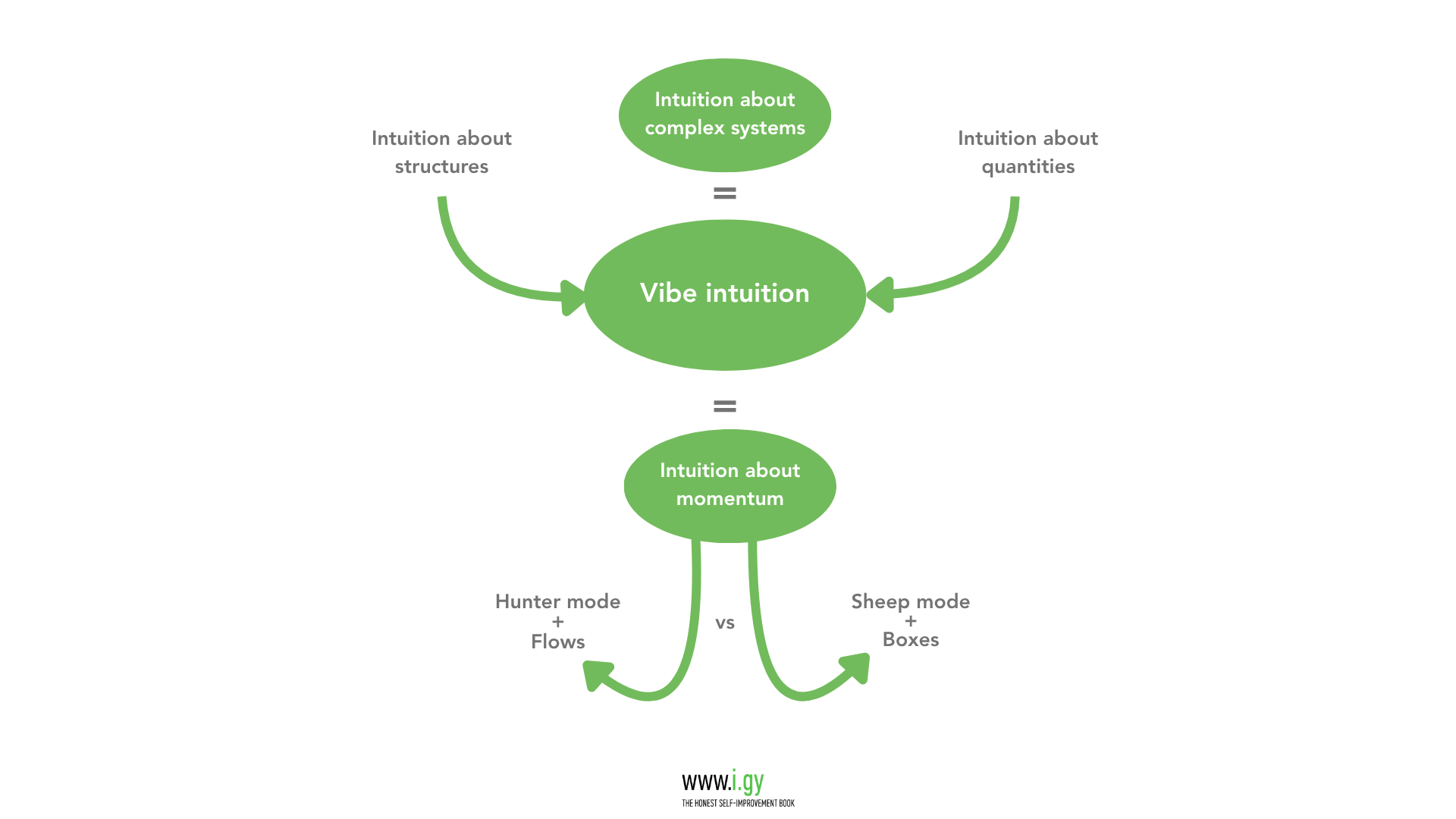
Vibe Intuition
Vibe Intuition deserves a special place. It is a combination of Intuition about structures and Intuition about quantities that observes how complex systems like humans, other living beings, but also organisations and societies, evolve over time and focuses on feedback loops and Direction.
This is very important for parents of older children. Don’t only ask:
“Is this good or bad?”
Ask:
Where is this going?
A friendship doesn’t have to be “toxic” today for its direction to be bad. A hobby doesn’t have to produce achievements today for its direction to be wonderful.
A teenager doesn’t need to be depressed before you notice their life has been gradually narrowing into
school → phone → sleep → school → phone.
Likewise, a child may have average results while their direction is fantastic:
more curiosity → more confidence → better friends → more projects → more competence → more Freedom.
That’s an upward spiral. The parent should become sensitive to momentum, not merely snapshots. And eventually teach the child to do the same.
Acceptance
Acceptance is about handling the past. Children need to learn:
“It happened. I don’t like that it happened. I can learn from it. It doesn’t need to define me.”
The danger here is Shame.
If a child is made to feel bad or even feel Guilt every time they make a mistake, they may focus on defending themselves instead of understanding what happened, accepting the mistake, learning from it, and moving on.
Mindfulness
Mindfulness is about handling the present. For a child, it is gradually developing the tiny space between:
“something happens → reaction“.
The parent can model that space:
“We don’t have to decide this second.”
“You’re furious. We can talk when you’re fine again.”
“Notice what you’re feeling before you answer.”
By adolescence, this becomes extraordinarily important around conflict, attraction, peer pressure, online provocation and status.
Direction
Direction is about handling the future. We strive for an Outward direction, towards a Hunter mode. And we try to save us from an Inward reaction that leads to Sheep mode. A wonderful parenting translation is: Don’t ask the child to have their life figured out. Teach them to take a good next step.
Children need increasing ability to sense:
“Which of my available moves opens life?”
And when something goes wrong:
“What is one useful thing we can do now?”
Hunter mode
Many games, sports and outdoor activities foster your childs Hunter mode – the Life direction you want to encourage in order to help them become independent, responsible and active young adults by the age of 18.
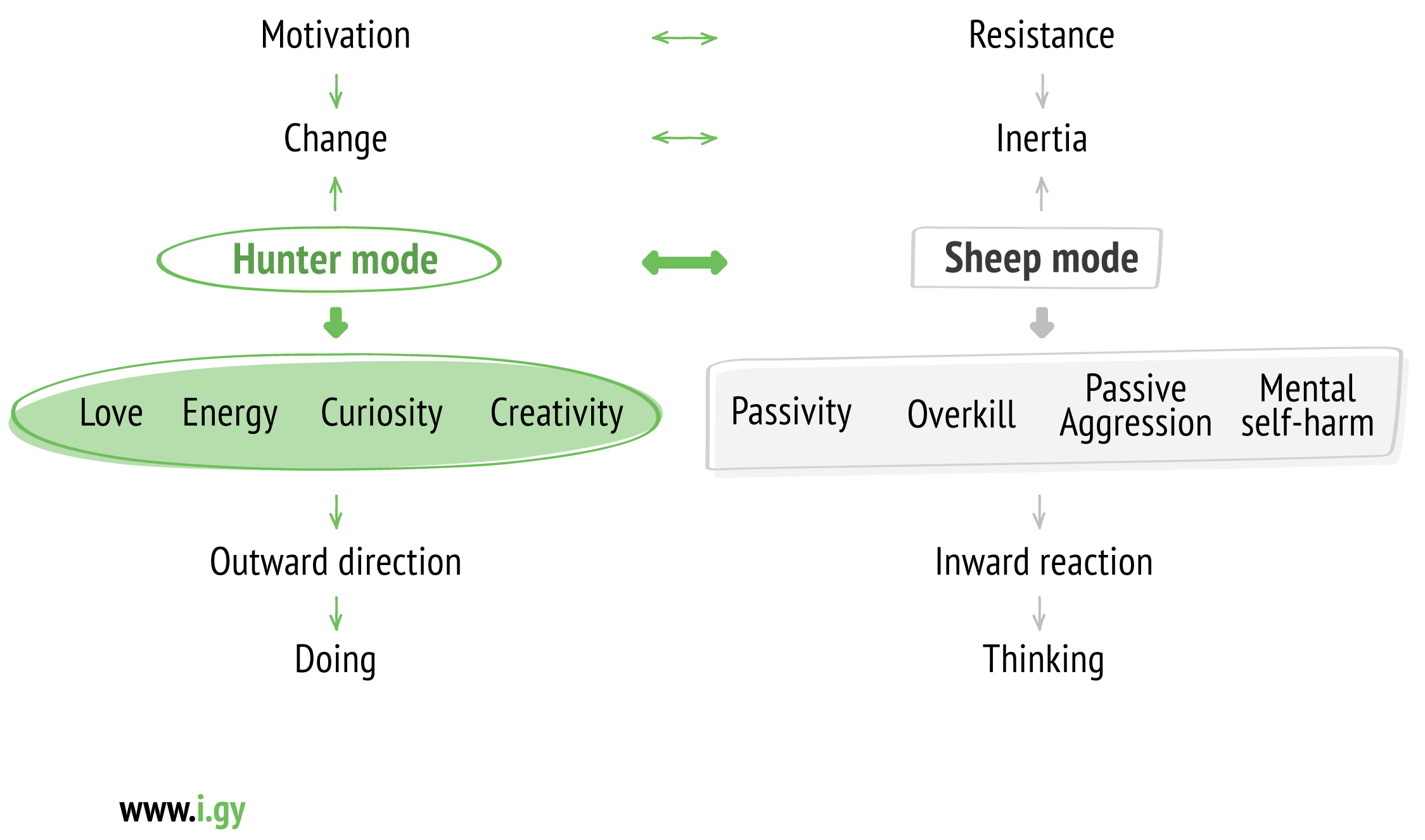
Evaluate the moves of your child, not the child. A child can be terrified and still make a Hunter move. A teenager can feel confident and make a Sheep move. The useful question is: “What is the smallest useful action available right now?”
“You forgot your homework? What can you do?”
“Your friend is angry? What can you do?”
“You failed an exam? What can you do?”
“You don’t know whether you like programming? Try it.”
“You want to make something? Start a first version.”
Present actions influence future ones – Hunter moves make subsequent Hunter moves easier, while Sheep moves can reinforce the opposite trajectory. This makes small childhood choices important without making their outcomes catastrophically important.
Education
If we want modern Education, we can give our children a computer or a laptop from a certain age onwards – preferably after 14 or at least after 12 – instead of a smart phone or tablet.
It’s extremely useful to teach them about the importance and Meaning of Science, numbers and money.
And, of course, we should not leave them in the hands of the old-fashioned school and educational system. Education should prioritize a supportive environment in which children care for one another and grow toward emotional intelligence, rather than reducing it to facts and performance.
Entrepreneurship
Children are natural-born Entrepreneurs. Give them the chance to develop their own and unique Business and gain as much Diversity of Experience as possible!
Diversity of Experience
Instead of giving children an identity, give them experiences from which an identity can continuously emerge. Science. Nature. Sports. Art. Building things. People. Animals. Music. Books. Travel. Work. Helping others. Technology. Entrepreneurship. Silence. Adventure. Allow interests to appear and disappear without treating quitting as failure.
The important distinction is between damage and difficulty. Protect children from serious damage. Don’t protect them from every difficult experience. Otherwise they never accumulate the Diversity of Experience from which Intuition emerges.
Failure should produce Diversity of Experience, not shame, guilt or poor self-worth. An experiment that fails still produced experience. A project that didn’t work still gave information. A sport the child quits after six months was not necessarily “wasted time.” They discovered something. Trying something that doesn’t work still produces useful experience; failing to try something that would have worked is the greater missed opportunity and the worst of all options. So you should avoid glorifying both extremes:
“Never quit.”
and
“Quit anything the moment it’s hard.”
Instead:
“What are we still getting from this?”
“Is the difficulty producing growth, or just consuming life?”
“What would we learn by continuing?”
“What would we gain by stopping?”
A child who does only the thing they’re currently best at accumulates depth but may lose width. So especially before adolescence, expose them to very different worlds. Science and art. Nature and cities. Old people and young people. Sports and books. Making things and discussing ideas. Helping somebody. Technology. Cooking. Travel. Music. Animals. Money. Small jobs and projects. Different cultures. But don’t turn Diversity of Experience into another parental Box:
“You must complete 12 enriching activities this semester.”
The point is not a résumé. The point is to give the brain data points. Then let Intuition form.
Money
A child should become increasingly precise and comfortable with money, because it strongly affects the Game of Life and Long-term Freedom. This means parents should not make money mysterious. Children can gradually encounter: prices, change, budgets, saving, spending, percentages, discounts, interest, income, taxes, subscriptions, risk, opportunity cost. Give the child €20 and let choices have consequences. If they spend all €20 today, do not immediately replace it tomorrow.
The lesson is not:
“Money is scarce, be afraid.”
It is:
“Money is a quantity. Decisions change that quantity.”
Then another important question appears:
“What do I get in exchange for this quantity?”
This develops Intuition about Quantities.
Science and Arts
Still, if you ask which school subjects matter most, the answer is arts, music, dancing and crafts up to around the age of 12 years. Wondering why? Because they stimulate s child’s creativity and help them remain in a Flow state. And when the most important Flows work together, they create the foundation for what we call Intrinsic motivation. We desperately need Intrinsic motivation throughout life.
At the same time, we should never neglect languages—especially the mother tongue and English—as well as maths. Mathematics is the foundation of science. It also develops our Intuition about structures, Vibe Intuition, Intuition about quantities, Intuition about large numbers, Intuition about thresholds and Time understanding.
Between the ages of roughly 12 and 16, science becomes especially important. This is the period when young people can build the foundations of Truth and truth-seeking – one of the most valuable skills.
And, of course, society needs engineers, doctors, researchers, and scientists of all kinds.
Spirituallity and Religion
What is true of Education is also true of Religion: children need Spirituality, yes, but they do not need to outsource their spiritual experience to a Religion.
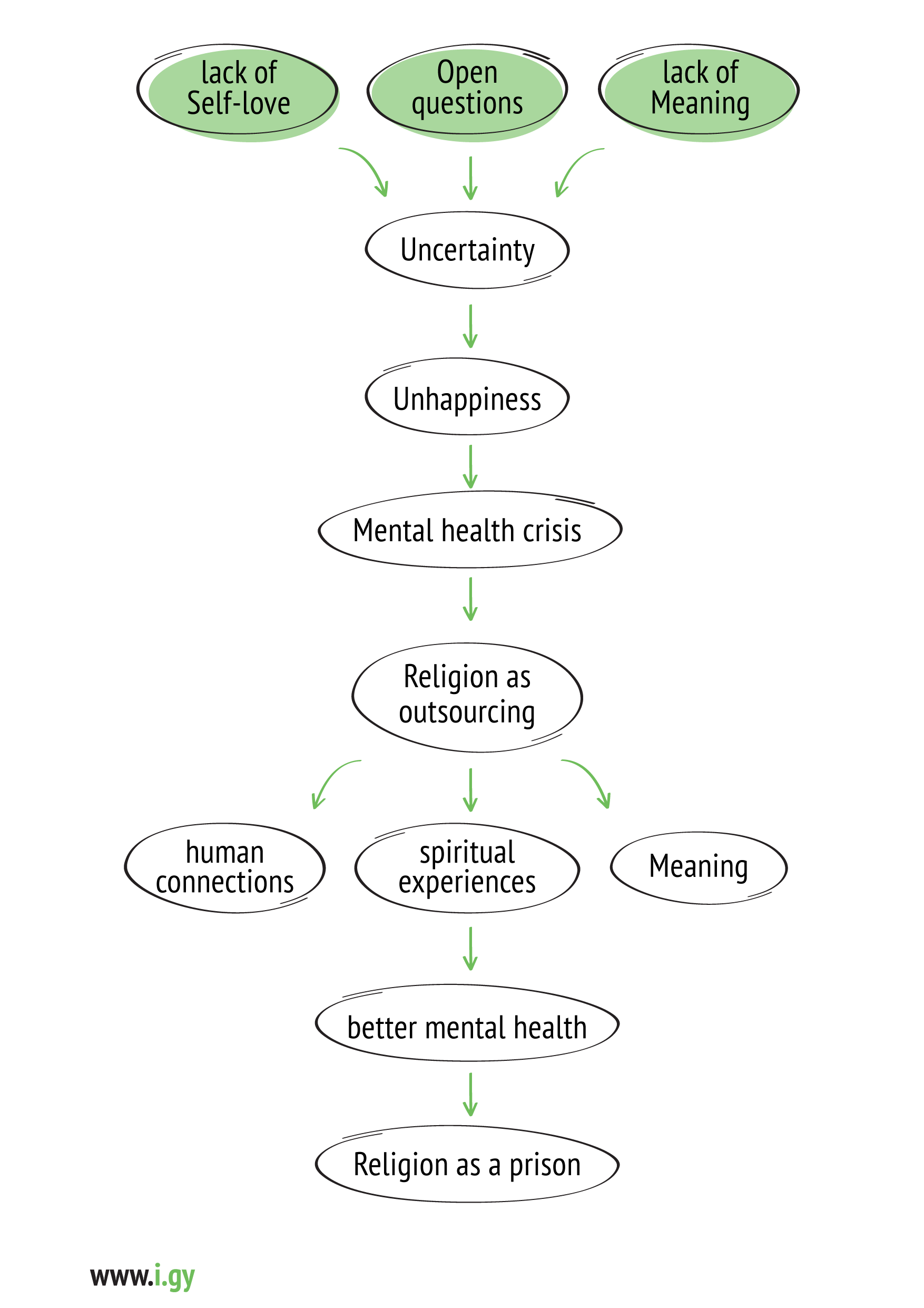
Sleep
A widely underestimated risk, not only for parents, but also for their children, is the lack of enough sleep. And guess what the main reasons are? Screens and the educational system. And who says that parents can’t protest alongside their children for a later start of the school day?
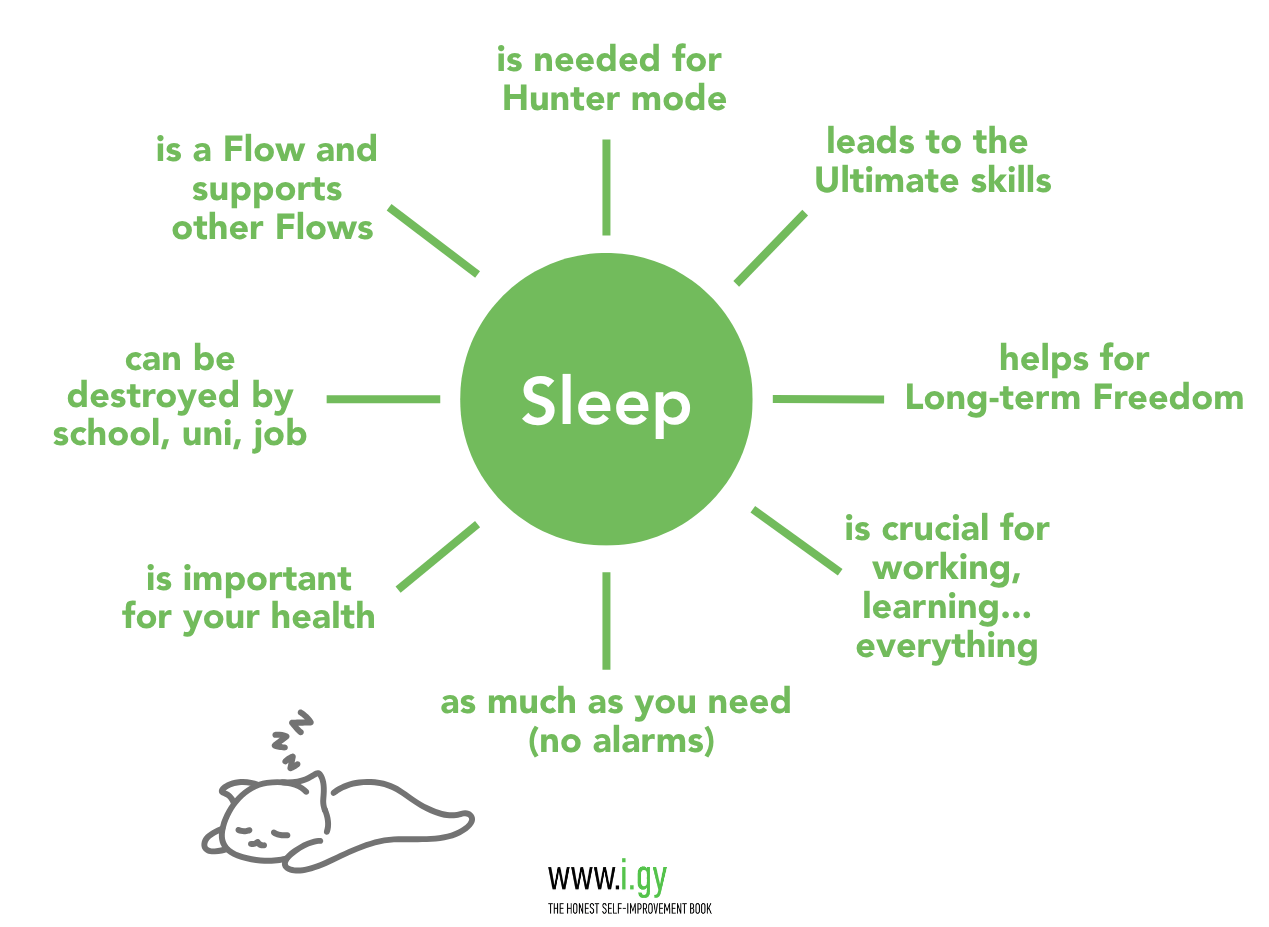
And insufficient Sleep leads to poorer health – weakened immune function, metabolic and weight problems, heart and blood-pressure problems. But also to poor concentration and memory, mood problems, daytime fatigue and sleepiness. Or, in other words, dramatically less effective learning process. And less Flows. Flow usually requires sustained attention, enough mental energy, a manageable level of arousal, and the ability to stay absorbed in a task. Sleep deprivation works against all of those.
Truth and Intellectual trust
As a parent, you must love your children and the Truth above all else. Without Love for Truth, Intellectual trust, and a strong connection to Science and the Scientific method, you and your children may very well end up in some Bullshit group. In a world in which not only people but also systems and companies seek to manipulate you, understanding and feeling the Truth is crucial for a fulfilled and happy life.
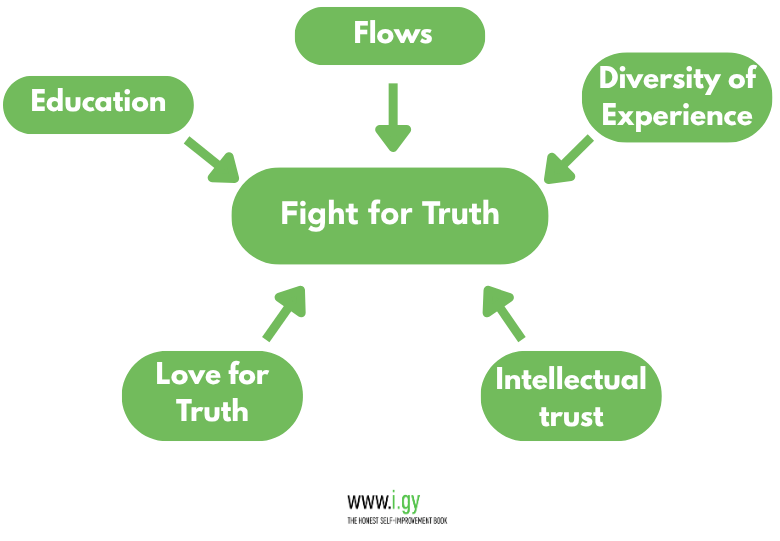
Teach the child to love Truth (reality) more than being right. A common parenting interpretation of Truth would be just:
Teach your child to tell the Truth.
That is necessary, but way too narrow. A deeper parenting approach will be:
Raise a child who wants to know what is actually true – even when the Truth is uncomfortable, contradicts what they already believe, or shows that someone they love is wrong.
That includes the child themselves. Truth, in this sense, is not only honesty. It is a relationship with reality.
The aim is not to have a child who is certain. The aim is to have a child who is curious, difficult to manipulate, comfortable with uncertainty, willing to revise beliefs, and increasingly capable of finding out what is likely to be true.
For a young child, parents have enormous emotional authority. The child depends on them for protection, affection, food, interpretation of the world and often their first ideas about good and bad. That means a parent can very easily create this unconscious equation:
I trust you emotionally → therefore what you say must be true.
But in I Grow Younger we show that Emotional trust is very different from Intellectual trust. Emotional trust concerns connection and the sense that another person is safe and benevolent. Intellectual trust concerns competence: whether this person actually knows what they are talking about.
This distinction is extremely important to teach children. A child should be able to think:
“My mother loves me deeply, but she might be wrong about this.”
“My teacher is a good person, but that doesn’t mean they know everything.”
“I like this YouTuber, but liking someone doesn’t make their claims true.”
And eventually:
“Someone I dislike may still be correct.”
This is intellectual maturity. One of the greatest gifts a parent can give a child is therefore permission to separate:
“Who do I love?”
from
“Who is correct about this particular question?”
The parent can model this directly:
“I think this is right, but let’s check.”
“I don’t know enough about this.”
“I was wrong.”
“You were right about that.”
“Your teacher may know more about this than I do.”
“I strongly believe this, but believing something doesn’t prove it.”
These sentences do something very important. They tell the child: Truth is above parental authority.
Let the child see you change your mind. This may be one of the strongest forms of Truth education available. Suppose the parent initially refuses something. Later, after hearing the child, they realize the child has a good argument:
“I’ve thought about what you said. You changed my mind.”
That is enormously educational. The child learns simultaneously that: authority can listen, arguments can matter, changing one’s mind is respectable, Truth matters more than ego, and disagreement does not threaten Love. The parent loses nothing important. In fact, the child’s Intellectual trust may increase precisely because they demonstrated that their beliefs are revisable.
A parent who cannot be wrong teaches obedience, not Truth. Imagine two households.
In the first, disagreement is interpreted as disrespect:
“Don’t argue with me.”
“I know better.”
“You’ll understand when you’re older.”
“Because I said so.”
The child may become very good at identifying what the authority figure expects them to say. But that is not Truth-seeking.
In the second household, parental authority still exists, but it is not confused with infallibility:
“I am responsible for this decision, so the final decision is mine. But you can still disagree with my reasoning.”
This distinction is powerful. A parent can say:
“You don’t have final responsibility yet, but you are allowed to think.”
That preserves both parental Responsibility and the child’s developing intellectual Freedom. There will be situations where the parent must decide. A five-year-old does not get equal voting rights on whether they need to sit in a car seat. But even when authority cannot be shared, Truth can be.
“I won’t let you do this because I believe it is dangerous. Let me explain why.”
That is very different from:
“It’s dangerous because I said it is.”
Parent-authority based on Love is extremely important and kind of synonym of Emotional trust, so we should not mix it with Intellectual trust. Otherwise we make the mistake to use sentences like the one above.
Truth also means allowing the child to discover that the parent is imperfect. Children begin by idealizing parents. Eventually they discover: Dad doesn’t know everything. Mom sometimes makes bad decisions. My parents have prejudices. They contradict themselves. They have fears. They have unfinished problems from their own childhood. Parents sometimes experience this loss of idealization as disrespect. It need not be. It can be an essential part of growing up. The ultimate goal is not:
“My parents were right about everything.”
It is:
“My parents gave me enough Love, Freedom, Diversity of Experience and thinking tools that I can understand things and find Truths they couldn’t.”
That is success. A child who eventually sees further than the parent is not evidence that parenting failed. It may be evidence that knowledge successfully moved forward one generation.
A very dangerous trap is rewarding the child merely for agreeing with you. Parents naturally feel good when their children adopt their values, opinions, tastes and interpretations of life:
“My daughter thinks exactly like me.”
It can feel like Success. From our perspective, however, this should make us cautious.
The child is building their own personal map. If agreement with the parent repeatedly produces warmth, praise and belonging while disagreement produces withdrawal, anger or ridicule, the child receives a powerful emotional signal:
Agreement = Love
That makes Truth very expensive. The child must then choose between:
“What do I actually think?”
and
“What keeps me connected to the people I depend on?”
For a child, emotional connection will often win. That is why Unconditional Love and Truth belong together. The child needs to know:
“You can disagree with me and remain fully loved.”
Only then is genuine intellectual exploration psychologically safe. We must be able to show our children Vulnerability, so they can learn how important it is to show your own vulnerability to other people.
Truth-seeking needs Flows and Love, and helping another person move closer to Truth requires Love, acceptance, vulnerability and care rather than facts alone.
Truth is carried by Love. Parents can make a serious mistake in either direction. One extreme is: Love without Truth. The parent avoids saying anything uncomfortable.
“You’re perfect.”
“The teacher is always the problem.”
“Anyone who doesn’t like you is jealous.”
The other extreme is: Truth without Love.
“I’m just being honest.”
“You’re lazy.”
“You aren’t good enough.”
“The world won’t care about your feelings.”
Never protect a child from reality by lying about it. Never use reality as an excuse to hurt the child.
A child can hear:
“You didn’t prepare enough for this exam.”
without hearing:
“You are a failure.”
“You hurt your friend’s feelings.”
without hearing:
“You are a bad person.”
“You aren’t ready for this freedom yet.”
without hearing:
“I don’t believe in you.”
Lern to separate child’s feelings from its factual conclusions. Suppose a child says:
“Nobody likes me.”
The parent should not answer:
“That’s ridiculous.”
Something is real. The child feels rejected. But the factual proposition “nobody likes me” may be false. So we can separate Emotional trust:
“You really feel alone right now.”
from a claim about the outside world:
“Let’s look at whether nobody l ikes you.”
This prevents two common errors. The first is invalidating the emotion because the interpretation is inaccurate. The second is validating the interpretation simply because the emotion is real.
A better response is:
“I believe that you feel this way. Let’s see whether the story your mind is building around that feeling is also true.”
That is a very sophisticated Truth skill. It respects the Game of Self while investigating the Game of Life
Truth needs psychological safety. This may be the deepest parenting implication. Changing your mind is psychologically difficult because a belief is rarely just an isolated fact. Beliefs become connected to: identity, family, friendships, status, memories, pride, fear, belonging.
So when a child discovers:
“I was wrong.”
they may hear something much more painful:
“I am stupid.”
Or:
“Mom will be disappointed in me.”
Or:
“My friends will laugh at me.”
Or:
“If this belief is wrong, maybe everything I believe is wrong.”
This is why shame is an enemy of Truth. Pressure, guilt and shame make people defensive, whereas safe space, Unconditional love and vulnerability make intellectual Change possible.
This gives us a very important parenting principle: Make being wrong emotionally cheap. If admitting a mistake produces humiliation, the child will learn to hide mistakes. If changing an opinion produces mockery:
“See? I told you!”
the child learns to defend bad positions longer.
If saying “I don’t know” makes them look stupid, they learn to bluff. But if the parent responds:
“Good catch.”
“That’s interesting. So what changed your mind?”
“I used to think that too.”
“Great – now we know more.”
then intellectual correction becomes normal. The child gradually learns: Being wrong is temporary. Refusing to learn can last much longer.
The ability to say “I don’t know” is part of Truth. Children often discover that adults dislike uncertainty. Ask an adult a difficult question and they may immediately produce an explanation, even when they do not actually know. Children notice this. And if parents pretend to know everything, children learn that competence means having an answer. But that is not the case. Competent experts do not always have an answer, are willing to be wrong, seek verification, use exact terms and distinguish facts from emotions. So one sentence deserves a respected place in family life:
“I don’t know.”
Followed by:
“How could we find out?”
That second sentence transforms ignorance into curiosity. This teaches something much more important than a particular fact:
Not knowing is not failure. It is the starting point of finding out.
The desired identity is not:
“I am someone who knows the Truth.”
It is:
“I am someone who keeps looking for it.”
That is a much safer identity because it survives being wrong.
The Truth framework connects naturally with the concept of Intuition about Quantities, especially probability. A teenager may say:
“I know she’s lying.” “How do you know?” “I just know.”
This is a useful moment. There is an important difference between: possible, probable, very probable and certain (known). A child should gradually become comfortable speaking in probabilities:
“I think this is probably true.”
“There isn’t enough information yet.”
“That explanation seems more likely.”
“I could be wrong.”
“I’d need better evidence before believing that.”
This sounds less powerful than certainty. In reality, it is much more powerful. Someone who must always be certain is easy to manipulate with confident stories. Someone who can hold probabilities is much harder to manipulate. This is where Truth, Numbers and Intuition about Quantities meet.
Children should also learn that there are different sources of information and that a fact or what they’ve heard is not straight the Truth. Teach children to ask: “How do we know?” One of the most useful questions a parent can normalize is:
“How do we know?”
Not aggressively. Curiously. A child says:
“Everyone knows that.”
“How do we know?”
or
“My friend said this food is dangerous.”
“How could we check?”
or
“This video says scientists discovered something amazing.”
“Where did the claim originally come from?”
or
“She definitely hates me.”
“What happened that makes you think that?”
The purpose is not to turn the child into a permanent skeptic who trusts nothing. That would create a different problem. The purpose is to teach them that claims have different levels of support. Some things are observations. Some are interpretations. Some are rumours. Some are hypotheses. Some are measurements. Some are expert conclusions. Some are advertisements. Some are personal experiences. Some are stories. And these are not interchangeable.
Teach your children to trust people differently for different things. You may trust someone to: give directions, but not hold your money. You may trust someone emotionally, but not medically. You may trust someone’s knowledge of mathematics, but not their judgment about relationships. You may trust someone in one context and not another.
Children need to learn to make a distinction between Truth and Perceived Truth. Perceived Truth is a belief shared by a group. It helps unite the group, but group agreement does not make the belief objectively true.
“Everyone around me believes it!”
is not evidence. This becomes particularly important in adolescence. Children increasingly enter tribes: friendship groups, school cultures, online communities, political communities, subcultures, influencer communities. Every group develops beliefs about: what is cool, what is embarrassing, who deserves respect, what success looks like, what relationships should look like, what kind of body is attractive, what kind of person is admirable. Inside the group, these ideas can feel like facts. A teenager may say:
“Everybody knows you need this phone.”
“Everyone thinks she’s weird.”
“Nobody wears that.”
“You can’t be successful unless…”
The parent should resist simply replacing one tribal Truth with another:
“Your friends are idiots. Listen to me.”
That merely asks the teenager to switch tribes. A better response is:
“Everyone in your group may believe that. But is it actually true?”
That distinction can become a lifelong protective mechanism: Popularity tells you what a group believes. It does not tell you whether the group is right.
Obvious lies are often relatively easy to identify. Partial Truth may be more dangerous than an obvious lie. Partial Truth is taking something genuinely true and presenting it in a way that supports a much larger conclusion that does not necessarily follow. It leads to the concept of Bullshit: partial Truth mixed with Usefulness and wrapped in an emotionally attractive Story.
This is highly relevant to the world children are growing into. An advertisement may use a true fact about a product. An influencer may tell a true personal story. A friend may tell the true part of an argument that makes them look innocent. A viral video may show a real event. A political message may contain several correct statistics. None of those facts automatically make the larger story true. A child has to learn to state the following question:
“What might be true here, and what conclusion am I being encouraged to draw from it?”
That is a much more advanced Truth-finding skill than simply spotting lies. Stories are powerful precisely because they do not feel like arguments. Children learn through stories, and stories are wonderful. But stories also create emotional certainty. A compelling story has: a hero, a villain, a cause, a conflict, a conclusion.
Reality is often less tidy: Someone can hurt us without being evil. Someone can be kind and still be wrong. A bad outcome does not prove bad intentions. A good outcome does not prove that the decision was wise. One personal story does not prove that something works generally. A parent can help children enjoy stories while teaching them that a good story is not always proof that something is true. This may become particularly important with social media, where powerful narratives can be compressed into seconds and repeated until they feel obvious.
“A beautiful story can contain Truth. But the fact that a story feels right does not prove that it is right.”
Parents also need to tell children uncomfortable Truths. Truth does not mean telling children everything immediately. Information has to be appropriate to what the child can understand and carry. But avoiding difficult reality indefinitely can also damage trust. Family financial problems. Illness. Conflict. Death. A parental mistake. A divorce. Children often sense that something is wrong before adults explain it. If the parent repeatedly says:
“Everything is fine,”
while the child clearly experiences that everything is not fine, an unfortunate lesson develops:
“My perception cannot be trusted.”
or even worse:
“I can’t trust my parents anymore. They are not telling me the Truth.”
or
“If even my parents don’t tell me the Truth, no one will do it.”
A better approach is age-appropriate Truth:
“Yes, something difficult is happening. It is an adult problem and you are not responsible for fixing it. We will tell you what you need to know, and you can ask us questions.”
The parent does not dump the entire adult burden onto the child. But they also do not require the child to deny reality.
The ability to search for Truth is connected with Diversity of Experience. You cannot teach Truth only by teaching the child your conclusions. You need to give them enough contact with different parts of reality to develop their own models. Different people. Different professions. Different countries. Different socioeconomic environments. Different books. Different cultures. Different ages. Different kinds of work. Different kinds of failure. Different explanations of the same event. If the child has seen only one world, that world feels universal. Diversity of Experience teaches:
“There are other ways human beings live and understand things.”
That does not mean all explanations are equally true. It means the child has enough data points to compare them.
Another challenge in front of parents and their children is to stay open-minded, but don’t believe everything. We do not want a child who believes everything. But constant suspicion is not Truth. Cynicism is not critical thinking. The better position is to demand evidence.
“I’ll consider it.”
“What supports it?”
“Who knows this?”
“What are their incentives?”
“Are there alternative explanations?”
“How probable are they?”
“What would change my mind?”
“Do I know, or am I guessing?”
“Am I believing this because it is true or because I want it to be true?”
Truth across childhood
With a very young child, Truth begins mainly with trustworthy reality. Parents name things accurately, keep promises when possible, acknowledge emotions and do not unnecessarily manipulate the child with invented threats.
As the child grows, Truth becomes curiosity: “How do we know?”, experimentation, checking, asking questions and being allowed to correct adults.
Later, it becomes source evaluation: who knows what, what evidence exists, the difference between popularity and expertise, fact and opinion, observation and interpretation.
In adolescence, it becomes much more difficult: identity, peer belonging, ideology, social media, sexuality, relationships, status, politics, money and the child’s emerging worldview all become entangled with what they believe. At that stage the parent’s strongest tool is probably no longer authority. It is the Emotional trust and the Intellectual trust built during the previous fifteen years.
If the teenager knows:
“I can tell my parent what I really think.
you have done good job in parenting.
Game of Self, Game of Life, Probabland and the Underworlds
A good understanding of the Game of Self and the Game of Life is also crucial so that you and your children do not dwell in Probabland or one of the Underworlds – the Mindless Underworld, the Escapist Underworld or the Delusional Underworld. What your child learns from your behaviour is very important – learning by example. If you manage well your Game of Self and your Game of Life, it is quite possible that your child will do the same.
Ask both the Vibe question – “How do you feel?” and the Time question – “What do you do all day?” The first is the central Game of Self and the second the central Game of Life question.
A child who says:
“I’m fine.”
but spends six hours alone scrolling is giving you very different information through the Time question. A child whose schedule looks perfect but says:
“I hate every day.”
is giving you equally important information through the Vibe question.
With children, the parent necessarily controls much of the Game of Life. You decide where a baby sleeps. You decide whether a four-year-old is allowed to cross a road. You decide whether an eight-year-old can stay alone overnight. You have responsibility for food, medical care, safety, shelter, education and protection from serious harm.
But this authority over the child’s Game of Life should not be mistaken for authority over their Game of Self. You cannot legitimately decide:
“You should like football.”
“You shouldn’t be scared.”
“You must love your grandmother.”
“You have to want to become a doctor.”
“You should be grateful.”
“You shouldn’t be angry.”
“You are an extrovert.”
“You are not artistic.”
The parent may guide actions. But the internal experience belongs to the child. This leads to an important parenting distinction: From the parent’s perspective the Game of Life (behaviour) of a child can require boundaries. But the Game of Self (feelings) usually require understanding. A child may be forbidden to hit someone. They shouldn’t be forbidden to be angry. A teenager may be prevented from doing something dangerous. They shouldn’t be required to agree that your preference is their preference.
Chaos and Structure
Chaos and Structure are the Universal forces. Chaos in the Game of Self is necessary for creativity, invention, development, Meta-skills and Ultimate skills. Chaos in the Game of Life can be destructive.
Children need Structure around safety. They need Chaos inside the safe space. The structure can include reliable caregivers, sleep, food, medical care, physical safety, nonviolence, basic respect, predictable protection and some household routines. Inside that structure, however, children need Freedom: Leave empty time; Let play evolve without adults deciding the game; Let a project change halfway through; Let interests appear and disappear. The parent designs the safety boundary. The child explores the Chaos inside it.
Compass of Forces
The Compass of forces is one of the most important concepts in I Grow Younger. It contains the universal forces Chaos and Structure on the horizontal axis and the Human forces Love and Fear on the vertical axis.
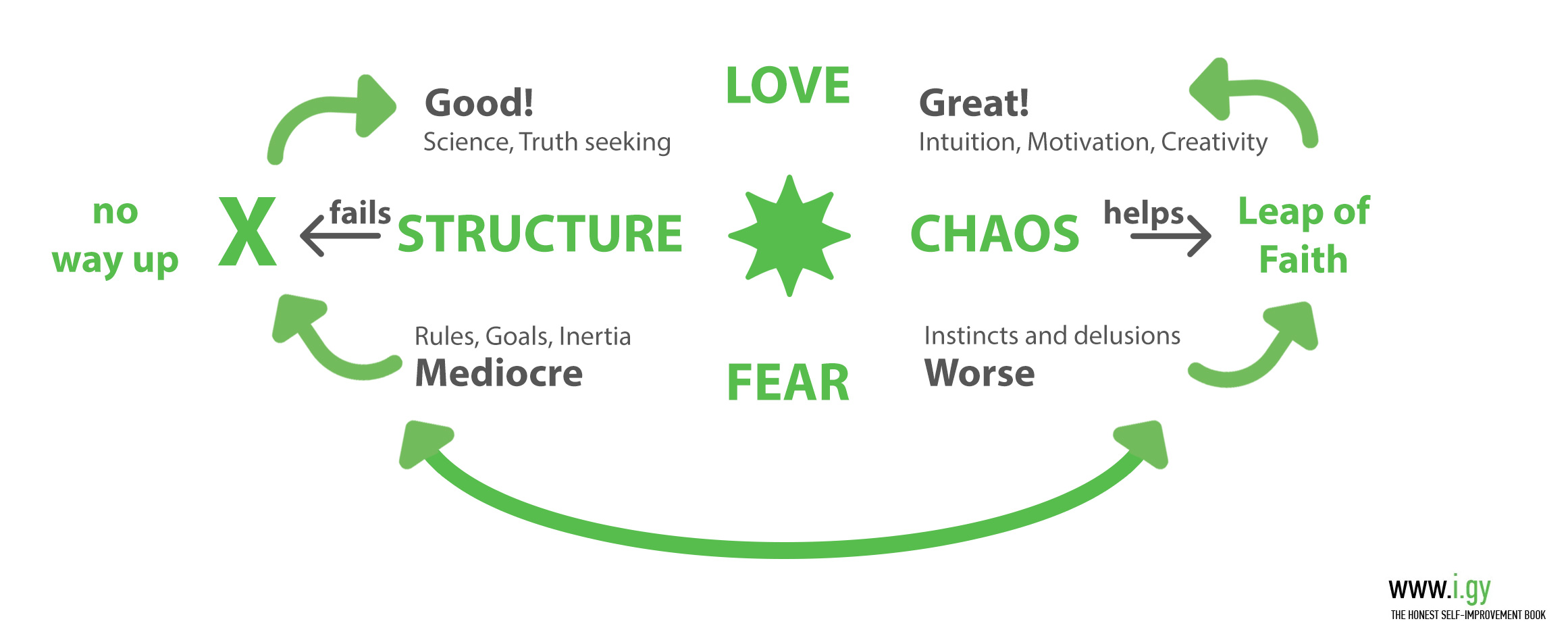
Applied to parenting, this creates the following:
Love + Structure is the secure home: dependable, understandable, safe, fair.
Love + Chaos is exploration: creativity, play, experimentation, adventure, improvisation.
Fear + Structure is authoritarianism: endless rules, obedience, guilt, punishment, excessive scheduling, obsession with “the right path.”
Fear + Chaos is instability: unpredictable punishment, emotional explosions, inconsistent rules, unsafe environments.
A good childhood needs a great deal of the upper half of the Compass of forces:
secure structures + loving chaos.
The child knows:
“My parents will be there.”
but also:
“I don’t know exactly who I’m going to become.”
That is a beautiful combination.
The Teenager
This is the age when you naturally feel stuck and Inertia takes over. Ideally, this should be the first and last time in your life when Inertia briefly dominates. On the other hand, this is also the age of Change. With a smart strategy on the part of parents and educators, every child can resist Inertia and become a real winner in life from an early age.
Between the ages of 12 and 16, during the teenage years, it is crucial to concentrate almost entirely on the Game of Life and explore the world – our reality. Diversity of Experience in the Game of Life is everything at this age. Science is extremely important, and Logic and logical thinking develop. This is the only age at which we may slightly favour the development of the Left brain and, to some extent, “neglect” the Right brain and Intuition. At all other ages, Intuition will be much more important and necessary, simply because it is more powerful.
First real attempts at Entrepreneurship, as well as real-life experiences with numbers and money, are the best education at this stage. Only at this age do we recommend some basic structure and even some discipline. Teenagers create their own Chaos all the time, so we do not need to encourage it further. The Ultimate skills of your children do not have to be addressed and developed deliberately – they will form beneath the surface and will become conscious by the age of 16.
The natural Chaos in the Game of Self can be very dangerous at this age and can lead to devastating problems, including all risks, Personal barriers and much more. On the other hand, just imagine how effectively it can be channelled and used in the Game of Life by allowing your child to build their first business.
The teenager needs meaningful decision-making power. Education choices. Activities. Friendships. Money. Time. Personal projects. Increasing privacy. Increasing responsibility for consequences.
This is also a wonderful period for small real-world experiments. Volunteer. Organize something. Sell something. Build something. Teach somebody. Start a project. Try freelancing. Make a website. Help run an event. Research a genuine question. Create art and put it in front of real people. Solve somebody’s actual problem. These experiences combine Chaos, Numbers, Structures, Responsibility, Truth, Meaning, Hunter moves and Diversity of Experience.
By sixteen the parent should increasingly be moving from manager toward mentor (adviser + safety net + source of Love + source of resources and experience). And ideally, the teenager starts coming to you voluntarily because your judgment is useful — not because you retain coercive power.
Entrepreneurship will help teenagers develop essentual skills – Ultimate skills, Intuition about numbers and money, Time understanding. With the right strategy, Time understanding and all the others skills, will form naturally.
The life stories of humanity’s greatest minds can give teenagers not only further inspiration and a firm anchor but also many ideas about how to become even better Entrepreneurs. And what could better develop Love for Freedom and the feeling of Freedom? These are the first seeds for your children’s future Long-term Freedom.
Freedom and Long-term Freedom
Parents choose the safe space of possibilities. Children choose inside it. Over time, parents expand the space.
The parent increasingly becomes an adviser after the age of 14-16. Talk through decisions rather than simply issuing instructions. Let the adolescent form views that differ from yours. Allow real decisions about education and interests. Help them understand consequences, resources, relationships and risks—but don’t write their future for them.
Long-term Freedom is the number of meaningful paths available to your child. And you should ask yourself whether the number of these meaningful paths is expanding or shrinking over time?
A child with perfect grades, no practical skills, crippling fear of failure, no independent judgment and no idea what they actually like may look extremely successful while their Long-term Freedom is quietly collapsing.
A child with imperfect grades, curiosity, strong Self-love, real-world competence, good relationships, many interests and the confidence to try unfamiliar things may have a much better future.
A parent may legitimately limit present Freedom to protect Long-term Freedom.
Allowing a seven-year-old unlimited sweets gives immediate Freedom while reducing future health-related options. Allowing a fourteen-year-old to abandon every commitment at the first unpleasant moment may increase today’s comfort while reducing future competence. Giving a six-year-old unrestricted internet access expands immediate options while exposing them to systems they cannot meaningfully navigate.
Responsability
Responsibility means:
“I understand why it matters and I act.”
A four-year-old can begin with putting toys away because a shared room needs care. An eight-year-old can help prepare food. A twelve-year-old can own a recurring household responsibility. A sixteen-year-old should be managing significant parts of their schedule, possessions, money, obligations and decisions. Whenever possible, explain who depends on the action and why. Chores then stop being arbitrary parental rituals and become participation in a system.
Meaning
IGY defines Meaning as the collapse of Barriers between the self and the world – seeing the Game of Self and Game of Life as one whole. That makes the classic adult question:
“What do you want to be when you grow up?”
rather poor. It prematurely asks for a Box. Doctor. Architect. Athlete. Programmer.
Instead ask:
“What do you care about?”
“What problem bothers you?”
“What do you love learning about?”
“Who do you like helping?”
“What feels worth doing even when nobody gives you a prize?”
Those answers can eventually produce careers, projects and responsibilities. But Meaning comes first.
Love, Self-love and Unconditional love
Love is crucial in every single relationship, especially between parents and their children. If you feel and show Unconditional love towards your child and Self-love towards yourself, it will be easier for your child to do the same. Unconditional love is the highest possible form of goodness that enables everything else. Self-love is the foundation on which you must build.
The child should receive a stable base of Unconditional love without learning that Love means absence of consequences.
“You are accepted.”
and
“Everything you do is accepted.”
are completely different.
And this protects Self-love. The child’s subconscious lesson becomes: My mistakes change situations. They do not change my worth.
Morality
Morality is closely connected to Self-love, although often not in the way you might expect. Many alternative and innovative pedagogies offer the same advice, which you should follow carefully: never try to “moralise” your children. Morality lectures and preaching are always counterproductive. Learning by doing and leading by example are the only solutions.
If you say mistakes are fine but become angry whenever something is broken, you are teaching something.
If you tell your child to think independently but become offended when they disagree with you, you are teaching something.
If you tell them that kindness matters but they watch you treat weaker people badly, you are teaching something.
The parenting question is therefore less:
“What should I teach my child?”
and more:
“What map is the child constructing from repeated exposure to me?”
You cannot directly program another brain. You can, however, influence what it repeatedly experiences, notices, values and expects. So a parent should rely much more heavily on environment, modelling, experiences and conversations than on moral lectures.
Language Use and the Trap-words
The language you use is crucial to your child’s early development. That is how we learn. Speak to your babies and children, and always try to use the right words. There should be a unique and understandable Meaning – and Truth – behind every word you use. This not only prepares your children for life but also helps prevent them from falling into common language traps. We can consciously give them – and their brains – an excellent start in the fight against Trap-words.
Human potential
And … always remember that your child has unlimited human potential!







Recent comments